Resilience Under Fire: Navigating the Accelerating Assault on Trans Identity

Since Jan. 20, 2025, the federal government has moved swiftly to erase transgender and nonbinary people from its own paperwork, ordering agencies to define sex strictly as the biological sex assigned at birth and banning the “X” marker on federal IDs. That order doesn’t just rewrite forms; it rewrites daily life. Passports, visas, and USCIS records now funnel people into categories many know to be false, while adjudicators can demand birth-certificate proof. Already-issued “X” passports remain valid until they expire, but renewals and new applications are being forced backward. In practice, that creates legal precarity on contact with airports, employers, schools, shelters, and police.
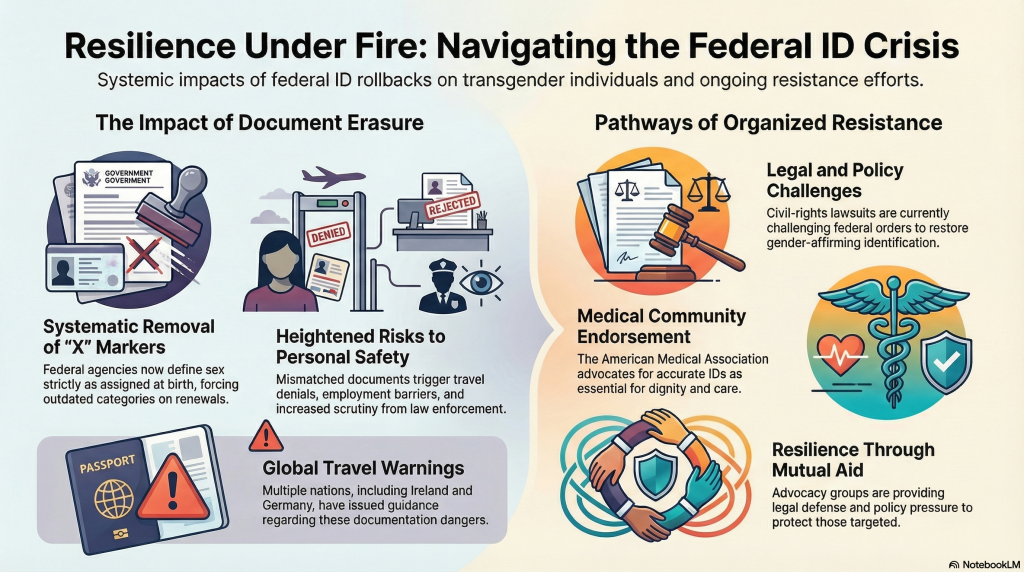
The harm spreads fast because identification governs movement, work, and survival. Mismatched documents trigger denials, information-request letters, missed flights, and heightened scrutiny. For transgender immigrants and nonbinary people, especially people of color and those without stable status, the rollback deepens exposure to detention, deportation, and profiling. Several countries, including Ireland, Denmark, Finland, Germany, and the United Kingdom, have issued travel warnings or guidance reflecting these dangers. Reports already describe visa problems and detentions tied to inconsistent or “X” documentation. A bureaucratic change becomes a border threat, and a border threat becomes a public-safety crisis.
Advocates are fighting back. Civil-rights lawsuits challenge the order, and the American Medical Association has backed gender-affirming identification as crucial to dignity and care. That support matters because document mismatches don’t only obstruct travel; they also disrupt medical access, insurance processing, pharmacy pickups, and emergency treatment. They make people think twice before reporting crimes or seeking help. Resilience, then, looks less like abstract inspiration and more like organized resistance: legal defense, mutual aid, policy pressure, and relentless testimony from those targeted. The record already shows what this assault does. The urgent question is whether institutions will stop enabling it.

 Activism and ChangeOctober 14, 2026I’m I7 and Male, I Don’t Know Whether or Not I am a Trans Girl
 Featured PostsOctober 13, 2026Colorado and Michigan Join States Ending Medicaid Coverage for Trans Youth
 Featured PostsOctober 8, 2026From Self-Doubt to Self-Acceptance: Confronting Internalized Transphobia
 Featured PostsOctober 8, 2026Say NO to Props 134 & 135 in Colorado