Two Lives, One Person: What I Learned Living as a Man and a Woman

You move through gender like a border crossing, stamped by voice, posture, clothes, and ritual rather than some stable inner truth. When you live as both man and woman, you witness how each role distributes power, intimacy, and surveillance along lines of class, race, and desire. Masculinity can grant quick belonging while taxing feeling; femininity can invite closeness while tightening control. What this split life costs—and exposes—doesn’t stay personal for long.
Crossing that line, Norah Vincent lived as “Ned” for 18 months because she wanted more than a theory about masculinity—she wanted to test how it feels from the inside. You can read her choice as immersive research methodology: entering male-coded spaces to observe friendship, gatekeeping, and emotional training without the filter of speculation or outsider access.
Yet the project also asks you to confront ethical implications. Vincent used disguise, performance, and selective disclosure, not simply to pass, but to expose how gender operates through institutions, bodies, and expectations. From bowling leagues to monasteries, she pursued masculinity as a social script shaped by power, sexuality, and belonging. Intersectionally, her experiment suggests that gender never stands alone; it gets enforced alongside norms of class, desire, embodiment, and emotional restraint.

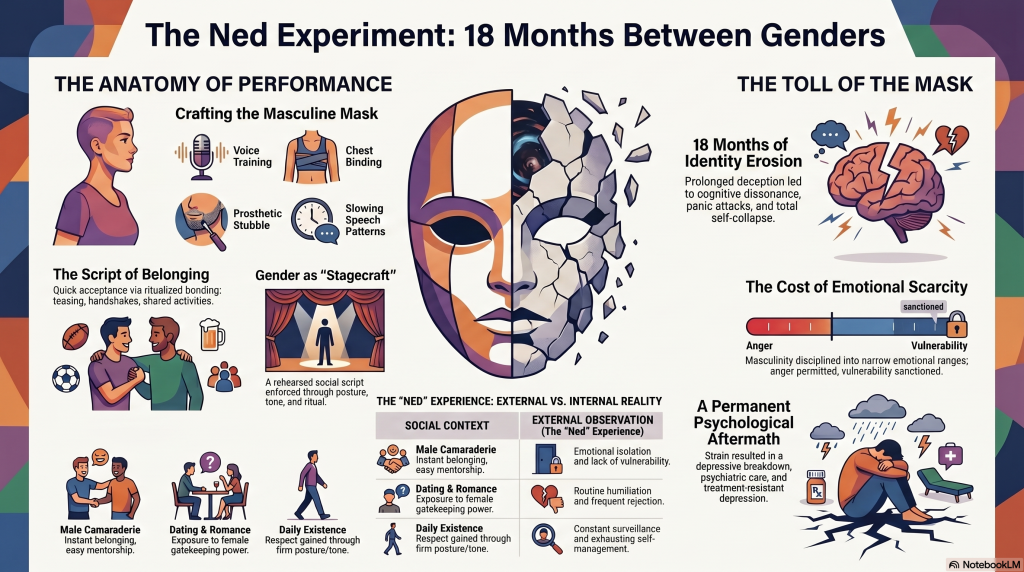
Adopting “Ned” didn’t just change Norah Vincent’s appearance; it reorganized the texture of everyday life through repeated bodily discipline, social coding, and emotional constraint. You learn that gender gets built through voice training, chest binding, weight routines, prosthetic stubble, and wardrobe rituals that begin before you leave home each day.
You slow your speech, drop your pitch, mute expressiveness, and move with practiced firmness. You alter your walk, tighten your handshake, and trim language until camaraderie arrives faster, as in the bowling league’s easy welcome. Work, dating, nightlife, and group activities all demand sustained performance, turning ordinary errands into continuous surveillance of posture and tone. Yet that access carries psychic cost: insomnia, panic, and cognitive dissonance accumulate, revealing how daily masculinity can require exhausting self-management for the body and mind.

Once daily masculine performance became routine, a harder insight came into view: living as “Ned” suggested that masculinity doesn’t simply grant power, it also disciplines men into emotional scarcity. You witness male emotionality narrowed by sanction: anger passes, vulnerability stalls, and whole inner worlds go untranslated. In bowling alleys and retreats, you behold social rituals do relational work quickly—handshakes, teasing, fleeting mentorship, covert aid—without the verbal intimacy often expected elsewhere.
You also learn how gender perception gets policed through appearance: features once read as butch become effeminate, and presumed sexuality shifts accordingly. In dating, repeated approaches and repeated rejection expose women’s gatekeeping power and men’s routine humiliation. Through that accumulation, you don’t romanticize men; you understand their silence as structured, their toughness as ritualized, and their need for emotional support as urgent.
Although the experiment yielded sociological insight, it also exacted a psychic cost that Vincent couldn’t contain. You watch identity erosion set in as performance becomes captivity: deception breeds cognitive dissonance, then anxiety, sleeplessness, and panic attacks. At the men’s retreat, failed emotional reciprocity becomes the breaking point; you witness how emotional exhaustion can turn observation into suicidal despair. A week after the final stint as Ned, she collapses into a depressive breakdown and enters psychiatric care.
Performance curdles into captivity, and the experiment’s insight gives way to panic, collapse, and psychiatric ruin.
You’re left confronting how embodiment, role strain, and social expectation intersect. In later years, treatment-resistant depression, repeated institutionalization, and ultimately physician-assisted suicide reveal that the aftermath wasn’t episodic—it became a prolonged catastrophe.
That collapse also clarifies what the experiment taught about gender: you don’t encounter “man” and “woman” as fixed essences, but as social scripts enforced through the body, voice, posture, and ritual. You learn how a buzz cut, bound chest, coached baritone, and practiced gait can trigger recognition, proving embodiment is read socially before it’s understood internally.
You also see how institutions police feeling. In male spaces, terse jokes, handshakes, and coaching create quick belonging, yet gendered language narrows emotional range, making anger safer than grief. Dating from the masculine side exposes rejection as routine and desire as regulated through heterosexual gatekeeping. Across these crossings, you grasp that gender never acts alone; power, vulnerability, and mental survival are distributed unevenly across bodies, histories, and expectations.
You’d conclude that Vincent’s experiment revealed how gender perception shapes everyday treatment, access, and emotional expression. As Ned, she gained male acceptance quickly, but you also see men’s hidden social isolation, ritualized bonding, and pressure to suppress vulnerability. The project made her more empathetic toward men’s struggles while exposing masculinity as a performance structured by power, expectation, and exclusion. It also severely strained her mental health after prolonged deception.
You’d describe the “woman dressed up as a man” experiment as gender disguise used for identity exploration and social observation. You perceive it in Norah Vincent’s project, where she lived undercover as “Ned” for about 18 months to experience male spaces firsthand. If you read it intersectionally, you notice how performance, power, and emotional rules shape gender. It wasn’t gender-affirming change; it was immersive reporting that exposed both male privilege and constraint.
You’re asking about *Self-Made Man* by Norah Vincent. In it, you follow a woman journalist who disguises herself as a man for 18 months to study male social life firsthand. The book examines gender performance and identity exploration through bowling leagues, workplaces, strip clubs, and retreats. You observe how masculinity can enforce emotional isolation, while an intersectional, reflective lens reveals the psychological costs of rigid gender expectations.
You’d say Norah Vincent viewed society as enforcing rigid social norms and distorted gender perceptions that wound everyone. She believed masculinity isolates men emotionally, rewards stoicism, and limits vulnerability, while femininity carries its own competitive pressures and inequities. Through an intersectional, reflective lens, you can see her arguing that power shifts by context: people gain certain privileges by performing gender, yet they also absorb psychological costs under society’s binary expectations.
You come away knowing gender works less like destiny than stagecraft: a script you rehearse until, like Tiresias, you can’t unsee the machinery. Passing grants you entry, but every doorway exacts a toll shaped by race, class, desirability, and power. You learn belonging can feel like exile from yourself. And when the costume starts to fuse to skin, you understand how institutions choreograph intimacy, loneliness, and survival—while calling that choreography natural.

 Featured PostsOctober 21, 2026The Trans Journey to Passing
 Featured PostsOctober 17, 2026From Job Search to Success: A Transgender Woman’s Employment Journey
 UncategorizedOctober 17, 2026Trans Rights at Risk? The Implications of a Trump 2024 Win
 Featured PostsOctober 17, 2026One Step Closer: Trans and Passing