Chasing Sanctuary: The Impact of Hostile Legislation on Transgender Migration

In recent years, hundreds of anti-trans bills have been introduced across the U.S., and that surge is pushing you to ask what it means when basic rights depend on your ZIP code. Hostile laws don’t just restrict care; they can upend your housing, schooling, work, and family stability. Some states now offer refuge, but protection is uneven and often costly to reach. What happens when sanctuary exists mostly for those who can afford it?
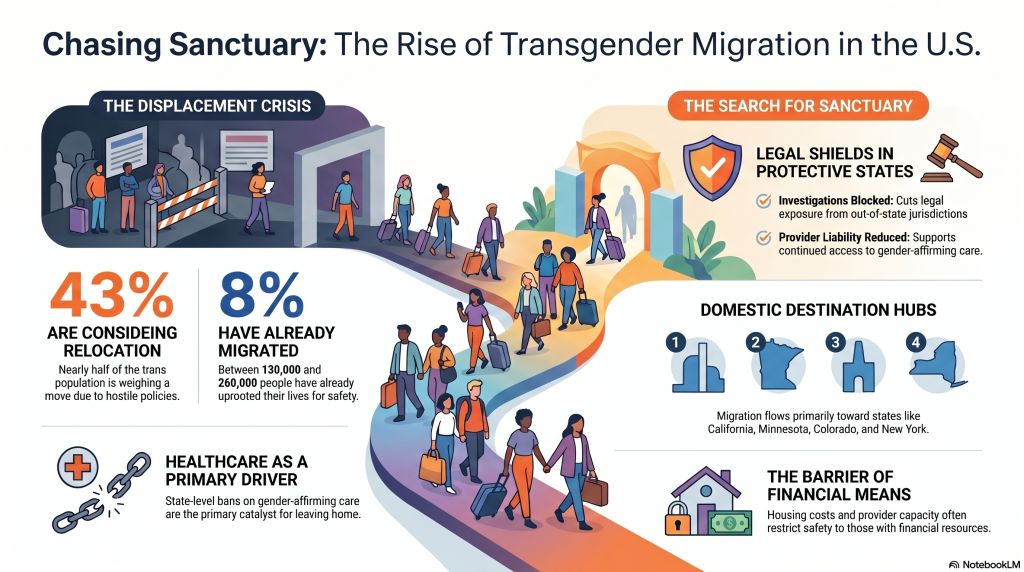
Increasingly, transgender people are leaving hostile states because anti-trans laws don’t just signal stigma—they directly threaten healthcare, safety, schooling, and family stability. If your state bans gender-affirming care, punishes providers, or restricts pronouns and bathrooms, you face direct harms to medical access, education, and parental rights. Data For Progress found 8% of trans people have already moved because of these laws, while 43% are considering it.
You also confront steep financial pressure. Lower-income trans people are often most motivated to leave yet least able to afford relocation, creating socioeconomic displacement and forcing losses of jobs, housing, and support networks. Safety concerns deepen the crisis: reduced travel, avoidance of hostile states, and heightened violence risks push you toward stability, while departures also produce community fragmentation for those left behind.

Across the country, transgender migration is clustering in states and cities that pair legal protections with practical access to care. You can see the pattern in sanctuary states like California, New York, Massachusetts, Minnesota, Washington, Colorado, and Illinois, and in metro hubs such as San Francisco, New York City, Boston, and Minneapolis. Polling indicates roughly 130,000–260,000 trans people have already relocated, while many more are weighing moves.
You’re also seeing urban clustering shaped by policy and economics. Protective state laws and local non-discrimination ordinances draw people toward places where rights are enforceable. Yet housing affordability, employment access, and moving costs still determine who can actually reach those destinations. Lower-income trans people often depend on relocation funds and mutual-aid groups, while some also consider emigration to countries with stronger LGBTQ+ protections.

When states ban gender-affirming care for minors, restrict treatment for adults, or expose providers and families to legal risk, they don’t just change policy—they disrupt continuity of care and make daily life less safe for transgender people. You can lose trusted clinicians, delay prescriptions, and face legal harassment for seeking medically necessary treatment.
Evidence shows these laws also reshape how you move through public space. Williams Institute research links enforcement of anti-trans policies to higher risk of public violence, while about 30% of trans respondents report traveling less often because they fear for their safety. That pressure carries clear mental health consequences. Data for Progress found at least 8% of transgender people have relocated and 43% have considered moving, yet cost, documents, and immigration barriers trap many in hostile states.
In practice, sanctuary-state laws protect you from some of the most immediate legal threats created by hostile jurisdictions: they can block state cooperation with out-of-state investigations, limit extradition or custody enforcement tied to gender-affirming care, and shield providers and families from civil or criminal penalties for obtaining or delivering that care.
| Protection | Effect | Limits |
|---|---|---|
| Investigations blocked | Cuts legal exposure | Varies by statute |
| Provider liability reduced | Supports access | Capacity still constrained |
You gain stronger footing for care decisions, especially in states like Minnesota or Colorado. These laws also help safeguard Prescription continuity and surgeries by reducing Provider liability. But evidence shows legal sanctuary isn’t self-executing: housing, insurance, employment, and local provider availability still shape whether you can actually use those protections safely and consistently.
Looking abroad can seem like the ultimate safety valve, but asylum isn’t a simple exit for trans Americans. If you seek protection in the Netherlands, you must satisfy refugee law by proving a well-founded fear of persecution as a particular social group, not just broad harm from hostile legislation. That creates serious evidence challenges, especially when 2025 U.S. executive orders restrict gender recognition and complicate records, IDs, and medical documentation.
You also face reception barriers: visa rules, limited housing capacity, and long processing times can block access before your claim is heard. Even with protection, integration demands language access, healthcare continuity, and community support. That’s why legal aid from ACLU, Immigration Equality, AsylumConnect, or Rainbow Railroad—and alternatives like work or study visas to rights-protective countries—matter greatly.
Yes—some countries may consider your asylum claim as a transgender American, including Canada, the Netherlands, Argentina, Spain, Ireland, and New Zealand. You must prove a well-founded fear of persecution with evidence like hostile laws, violence, or denied healthcare. These aren’t guaranteed pathways, and legal routes remain demanding. You should also weigh cultural reception, visa rules, processing delays, and legal support before deciding.
Yes, you can clearly see LGBTQ issues in migration. You find that legal frameworks shape whether people move for safety, healthcare, family recognition, and asylum protections. Evidence shows many LGBTQ people relocate domestically or internationally when discrimination, criminalization, or service bans threaten their rights. You also see social integration matter after arrival: housing, employment, healthcare, and community support determine whether migrants can rebuild stable, dignified lives in new places.
You’re marginalized when laws, institutions, and daily practices deny your rights, safety, and recognition. That’s just the tip of the iceberg: you face social exclusion in schools, workplaces, housing, and health care, while economic disparity limits jobs, income, and mobility. Evidence shows hostile policies increase discrimination, violence, and document barriers. If protections weaken, you’re pushed out of public life and blocked from equal citizenship.
You can’t treat transgender migration as a personal choice divorced from policy. When states criminalize care, weaken schools, and invite discrimination, you force people to vote with their feet—if they can afford to. Sanctuary laws matter, but they’re not a silver bullet without housing, jobs, documents, and clinical capacity. If you want rights to mean something, you must pair legal protections with material support; otherwise, safety remains a house built on sand.

 Featured PostsOctober 21, 2026The Trans Journey to Passing
 Featured PostsOctober 17, 2026From Job Search to Success: A Transgender Woman’s Employment Journey
 UncategorizedOctober 17, 2026Trans Rights at Risk? The Implications of a Trump 2024 Win
 Featured PostsOctober 17, 2026One Step Closer: Trans and Passing