Anti-Trans Attacks Are Reaching a New Level
You can’t turn on the news without tripping over another anti-trans bill. You’re watching near-identical, model-based proposals spread across statehouses, from bans on gender-affirming care for minors to restrictions on bathrooms, sports, and identity documents. You can track the same language, the same sponsors, and the same national groups pushing them, often with new criminal penalties and forced outing rules. The question is who’s coordinating it—and what changes when federal policy joins in…
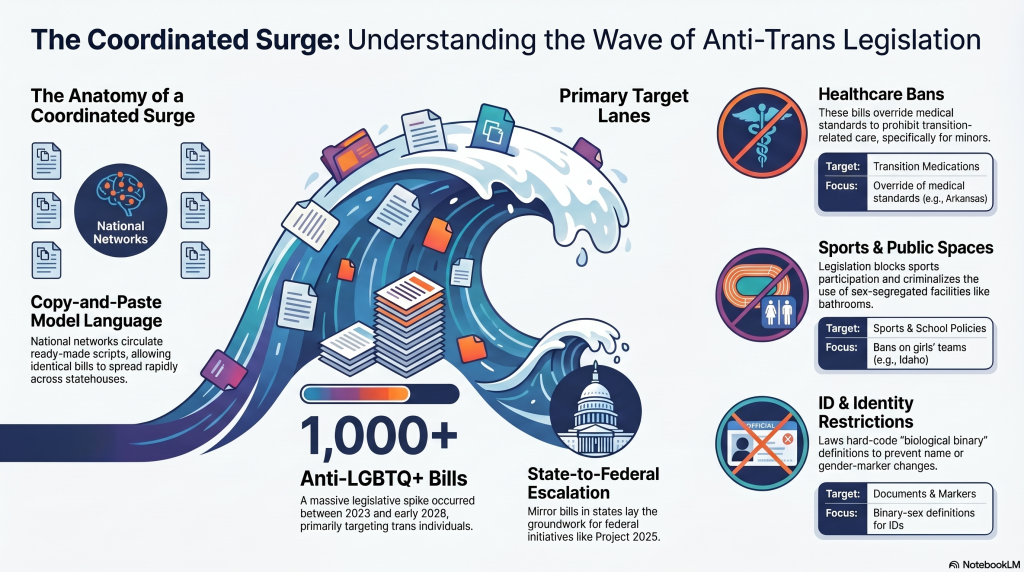
Look past the slogans and you’ll see a fast-moving wave of model-based anti-trans bills spreading across statehouses, often with near-identical language traced back to templates originally pushed in places like South Dakota. You can track four main targets: bans on gender-affirming care for minors (as in Arkansas), restrictions on school spaces and policies, limits on sports participation (Idaho’s early measures), and tighter rules for changing identity documents. You’re also seeing “forced outing” mandates for teachers and clinicians (Idaho, March 2026) and rollbacks of civil-rights protections (Iowa, 2025). Many proposals add registries, felony-level penalties, and strict “biological binary” definitions of sex, raising public health concerns and predictable legal challenges.
Because national organizers have handed state lawmakers ready-made scripts—and the media ecosystem keeps rewarding the panic they generate—anti-trans bills are accelerating as a coordinated campaign rather than a series of isolated local debates. You can trace the surge from mid-2010s growth to early 2026 spikes, as dozens of states introduce near-identical text built from model language initially tested in South Dakota and refined by religious-right networks and Project 2025–linked efforts. The numbers document intent: more than 1,000 anti-LGBTQ+ bills appeared in 2023–2024, with most targeting trans people and dozens becoming law. Media amplification turns disinformation about schools, bathrooms, sports, and care into voter pressure, while federal rhetoric and policy signals legitimize the push amid political realignment nationwide.

That coordinated surge shows up in the bill text itself: state proposals now concentrate in four repeatable lanes that organizers can copy, rename, and refile. Initially, healthcare bans target gender-affirming care, like Arkansas’s 2021 prohibition on transition-related medications for minors, letting politicians override medical standards. Subsequently, Sports bans block transgender girls from girls’ teams, following Idaho’s 2020 law and the wave of near-identical bills since. Third, ID restrictions choke legal recognition by limiting name or gender-marker changes and by hard-coding “biological binary” definitions into statutes. Fourth, “spaces” bills try to force you out of sex-segregated schools, restrooms, and other public facilities; some proposals attach criminal penalties, with reports of bathroom bans carrying sentences up to five years.
Although lawmakers often claim they’re responding to local concerns, the paper trail shows anti-trans bills spreading through copy‑and‑paste model language that initially circulated out of South Dakota and then reappeared—nearly verbatim—in dozens of state proposals. They can track the fingerprints: religious-right affiliated groups workshop “ironclad” wording, then share coordinated strategy so legislators can file matching bills fast. Transitics and the Project 2025 Tracker documented the early‑2026 surge, with mirror bills popping up across dozens of states and acceleration noted by February. Even when bills stall, repetition shifts media framing toward bathroom panic, school “indoctrination,” and competitive fairness claims. That narrative primes campaigns and pressures agencies. They will need legal counters that cite the shared text, demand disclosures, and challenge manufactured rationales in court.
Copy‑and‑paste state bills don’t just shift culture-war headlines—they also lay groundwork for federal action that can magnify harm nationwide. Project 2025 Tracker (Apr 2, 2026) shows draft policies (~50% complete) redefining sex as a “biological binary,” and proposing to criminalize educators and librarians, even via registries. When paired with a Sept. 2025 executive order labeling “gender extremism” alongside “antifa” under domestic-terrorism framing, you can face Federal investigations without any violent conduct. Recent federal moves also widen Medical access barriers—targeting Medicaid coverage, forcing some incarcerated trans people to detransition or be mis-housed, and exploiting shifting doctrine after Chiles v. Salazar.
Copy‑and‑paste state bills can become federal machinery—binary sex mandates, educator registries, terror framing, and widening medical and carceral harm.
Start by searching WPATH’s provider directory and GLMA’s LGBTQ+ clinician list, then filter for gender affirming clinics near you. Call offices and ask about pronouns, informed-consent HRT, insurance, and staff training; you’re verifying policies, not vibes. Use local LGBTQ+ centers for vetted referrals, including inclusive therapists. Check state licensing boards for discipline history and confirm telehealth options. If you’re unsure, request a brief consult and document answers.
Document each denial (dates, emails, witnesses) and request a written policy review while asserting your affirmed name/pronouns. Use Name advocacy: submit forms, update rosters, and ask staff to correct mistakes promptly. Use Classroom advocacy: meet the teacher, set expectations, and enlist an ally to reinforce them. If it continues, escalate to the principal, district Title IX coordinator, or superintendent. Contact ACLU, GLSEN, or Lambda Legal for guidance.
You’re mapping a trip when, coincidentally, your GPS reroutes near a border—use that moment to finalize a safety plan. Build Emergency routes (alternate highways, safe stops, local clinics), share itinerary/check-ins, and set a meet-up protocol. Create Documentation backups: encrypted scans of IDs, prescriptions, custody papers, insurance cards, stored offline/secure cloud. Verify state laws via ACLU/Trans Law Center, save hotline numbers, and keep meds accessible, not packed.
You can get legal help by contacting your state’s legal aid office, local bar association referral line, or LGBTQ+ legal groups like Lambda Legal and the ACLU. Ask community centers about legal clinics that offer low-cost consults. If you’re harassed at work or school, file with the EEOC or your state civil rights agency and keep copies. Carry know your rights cards, document incidents, and request written outcomes.
Like a sturdy bridge in a storm, you support trans people by showing up consistently. Donate intentionally to vetted mutual-aid funds and legal orgs (track impact, set recurring gifts). Volunteer locally with LGBTQ centers for rides, court accompaniment, or event staffing. Use your workplace power: push inclusive policies, report harassment, and fund benefits. Back your words with measurable commitments, timelines, and follow-through, and ask trans folks what help they want.
You’ve seen the pattern: near-identical bills move fast, copy-pasted across states, then sharpened with penalties, registries, and forced disclosures. You can track who wrote them, who funded them, and who votes yes—because the receipts exist in bill text, committee records, and model-legislation hubs. But the next step isn’t in the fine print. It’s in federal alignment—Project 2025-style policies that could lock these bans in. You’ll want to watch what happens next.

 Featured PostsOctober 8, 2026Say NO to Props 134 & 135 in Colorado
 Featured PostsSeptember 29, 2026A Kansas Law Voided 1,700 Licenses. Now Judges Must Decide Whether It Stands
 Featured PostsSeptember 29, 2026Election Season & Transgender Rights: Reporting Responsibly in a Divided America
 Featured PostsSeptember 29, 2026Privacy, Dignity, and Rights: The Transgender Bathroom Controversy