How Many Trans People Have Moved From Red States to Blue States and What States Are They Moving To?

Since the 2024 election, you’ve seen a striking shift: about 9% of transgender adults—well over 400,000 people—are estimated to have moved across state lines, largely away from Republican-led states passing anti‑trans laws. The biggest outflows appear in Texas, Tennessee, Louisiana, and North Carolina, while arrivals concentrate in Minnesota, Washington, California, Oregon, Colorado, and key swing states. What’s driving these choices, and how might they quietly reshape the country next?
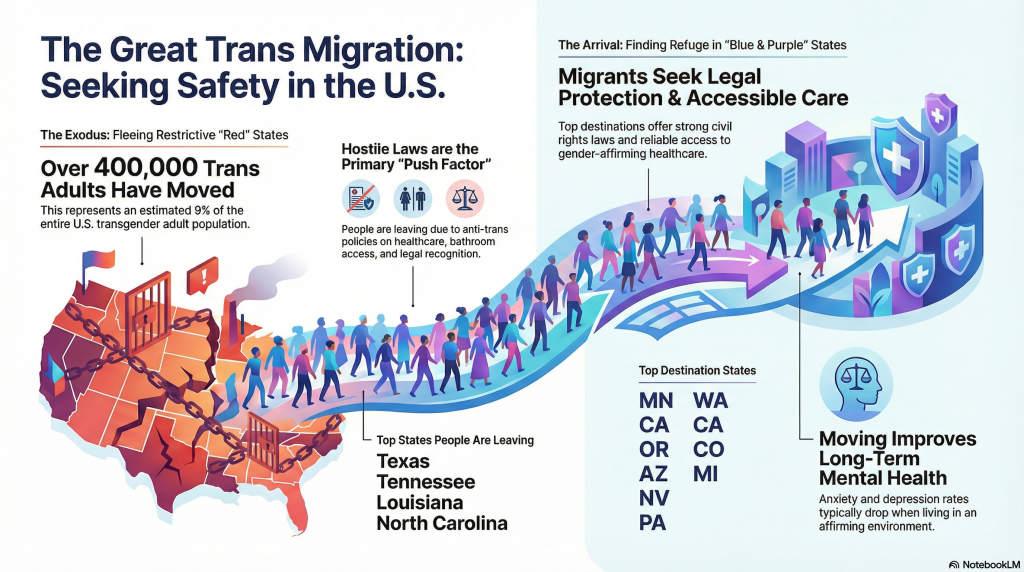

Although the exact figure will keep shifting as people continue to move, current data show a sizable migration already underway: a Movement Advancement Project/NORC poll found that 9% of transgender respondents reported moving to a different U.S. state after the 2024 election, which, when extrapolated using Gallup’s estimate that 1.3% of U.S. adults are trans, suggests that well over 400,000 transgender people have relocated across state lines in that period.
When you zoom out to the broader LGBTQ+ population, MAP/NORC data indicate about 5% of non-transgender LGBTQ+ adults also changed states, implying roughly 1.5 million interstate moves. You can see how policy impacts scale: as states diverge on healthcare and legal protections, you’re watching a measurable demographic reshuffle, often coordinated through community networks that share resources and information.

As state laws on gender‑affirming care, bathroom access, and legal recognition have hardened along partisan lines since 2024, you can see a clear push factor emerging in the data: large shares of transgender adults now describe remaining in many Republican‑led states as untenable. Surveys show 56% of trans people report discrimination and 47% report in‑person harassment, indicating daily environments feel unsafe.
You’re also seeing institutional harms: 24% report discrimination or mistreatment by local or state government. Anti‑trans legislation and hostile policies directly shape relocation decisions, pushing people toward jurisdictions with stronger social support, legal advocacy, and health‑care protections. Yet cost, employment, housing, and immigration barriers mean many who want to leave can’t, creating a stark gap between desire to migrate and actual moves.

Frequently, the migration data points to a clear pattern: transgender people are disproportionately leaving a subset of Republican‑led states where anti‑trans policies have intensified most. In the MAP/NORC poll, an estimated 9% of transgender adults—over 400,000 people nationally—moved across state lines after the 2024 election, and you witness the sharpest outflows from states layering bans and restrictions.
Anti‑trans policies are driving a measurable exodus of transgender adults from Republican‑led states after the 2024 election
You can track the trend in four especially high‑pressure environments:
Often the clearest pattern in the new migration data is where transgender people are going: a concentrated flow from Republican-led states into a handful of blue or purple jurisdictions with strong legal protections and accessible care. You notice Minnesota emerge repeatedly as a top destination, combining strong civil-rights laws, relatively lower housing costs, and reliable health access.
Movement Advancement Project scores and crowd-sourced reports point you toward a short list of preferred states: Minnesota, Washington, California, Oregon, Colorado, plus purple options like Arizona, Nevada, Michigan, and Pennsylvania. In the 100-person mover sample, common routes (TX→AZ, TX→NV, NC→MI, TN→MI, LA→PA) show you targeting safer jurisdictions that function as community hubs, where anti-trans hostility is lower and gender-affirming services are easier to reach.
In the span of just a few years, trans migration has begun to measurably reshape the country’s demographic and political landscape. You’re watching more than 400,000 trans people shift away from hostile red states, alongside about 1.5 million other LGBTQ+ movers, creating new clusters of voters, patients, workers, and organizers.
You can see the changes in four interlocking trends:
You observe families with trans children managing forced moves through difficult family relocation decisions, increasing custody disputes, and complex co‑parenting arrangements. Some parents split households across states to preserve school, healthcare, or legal protections. Population data show rising multi‑state living, emergency moves after new laws, and reliance on mutual aid networks. Trends indicate disproportionate burdens on low‑income and multiracial families, who face higher housing, employment, and healthcare access barriers.
You typically rely on layered support: grassroots mutual aid networks, GoFundMe-style campaigns, and trans-led relocation funds that track rising requests from hostile states. You often tap housing co ops and queer roommate networks that lower rent and deposit barriers. Data from LGBTQ+ organizations shows growing demand for emergency grants, legal aid, and travel vouchers, while many of you coordinate moves through online spreadsheets, signal-boosted lists, and local community centers.
Moving typically improves your mental health over time if you gain legal protections, access to care, and visible community. Population studies show anxiety and depression rates drop when your environment affirms your gender, supporting greater longitudinal wellbeing and identity stability. You’ll still face stress from disruption, costs, and possible discrimination, but, on average, trans people in affirming states report better life satisfaction, safer daily experiences, and more consistent access to gender‑affirming resources.
Like a patchwork quilt, rural acceptance in blue states varies sharply by county and town. You’ll see gradual improvement where local policies protect gender identity and healthcare access, especially near universities or growing metros. Yet many rural counties remain hostile, with stagnant or worsening attitudes. Population data suggest a slow, uneven trend toward affirmation, driven by younger residents and state-level protections, but local leadership and religious dynamics still heavily shape outcomes.
Immigration status and visas strongly limit your ability to move states because federal rules tie you to specific employers, schools, or locations. Immigration barriers and visa instability reduce interstate mobility for trans people, even when anti-trans laws rise. Population-level trends show noncitizens move less often than citizens, and trans migrants face added risks: loss of legal counsel, health coverage disruptions, and fear that address changes could trigger immigration scrutiny or status problems.
You’ve watched the numbers tell a neat story: over 400,000 trans adults uprooting their lives, red-state populations “solving” their culture war by exporting people, blue and purple states quietly importing talent, patients, and voters. You don’t need a moral lecture; the migration trends already deliver the punchline. When policy treats you as a problem, you move. When policy treats you as a person, you arrive—along with your tax dollars, skills, and demographic momentum.

 Featured PostsSeptember 5, 2026Administration Move Targets Trans Visibility
 Featured PostsAugust 27, 2026A Guide to Dating a Trans Woman
 Featured PostsAugust 27, 2026What Is Gender Dysphoria, and How Is It Treated?
 News and AdvocacyAugust 27, 2026Trump Says Hospitals Are Reversing Trans Surgeries “At My Order” — There’s No Evidence