Being Trans in Public: Staying Safe During a Transphobic Encounter

You’re waiting for the bus when a stranger starts misgendering you loudly and moving closer. In that moment, you don’t owe anyone an explanation—you owe yourself safety. You can steady your breathing, scan for the nearest staffed business or well‑lit crowd, and keep your body angled toward an exit with your hands visible. If you’ve set a code word with someone you trust, now’s the time to use it. Next, you’ll decide what to do if leaving isn’t possible yet.
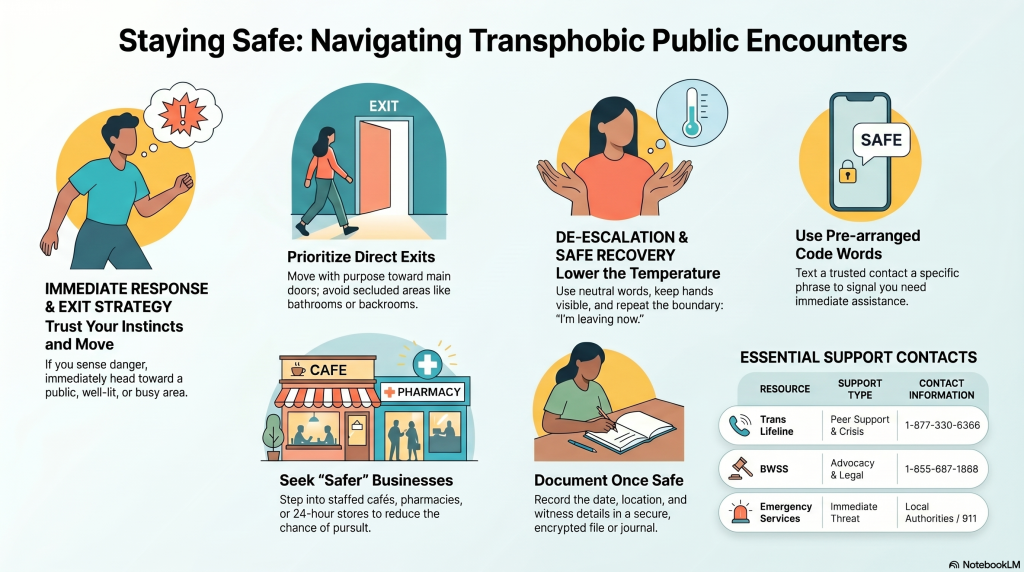
If you sense immediate physical danger, trust that signal and get yourself out of the area as quickly and calmly as you can—head toward a public, well‑lit place or a preplanned exit you’ve practiced so your body can move even under stress. If leaving isn’t safe, use emotional grounding: feel your feet, slow your breath, and focus on one concrete next step. Send a pre‑arranged code word to a trusted friend or neighbor so help can move toward you. Protect your digital privacy—don’t search for shelters on shared devices; call from a safe phone. When you’re safe, document what happened (date, time, location, words/actions, witnesses) in a hidden journal or secure file. If there were threats, assault, or stalking, contact emergency services or an advocate to understand your legal rights.

In a moment of threat, move with purpose: take the most direct exit you’ve already scoped out, skip bathrooms and secluded back areas, and head straight for a busy, well‑lit spot or an open business where staff are clearly visible. Use route rehearsal so your body knows the main door, side door, or transit stop without thinking. If you can, merge into a crowd; staying near other people is one of the simplest visibility strategies, and it often discourages pursuit. Keep 2–3 nearby “safer” businesses in mind—staffed cafés, pharmacies, or 24‑hour stores—and step inside.
> In a threat, move with purpose: take your planned exit, avoid secluded areas, and head to visible staff, crowds, and well‑lit businesses.

When leaving isn’t possible yet, you can lower the temperature of the moment while you set yourself up to get out safely. Use calm, neutral words and a steady, quieter tone; avoid accusations or debating your identity. Keep calm bodylanguage: hands visible, shoulders loose, and stand slightly sideways so you look nonthreatening while staying mobile. Position yourself with a clear path to an exit.
If they’re verbally aggressive, name it briefly: “I hear you’re upset,” then set a boundary: “I’m leaving now.” Repeat, don’t argue. If you’re with someone, use coded signals or a prearranged phrase like, “Can you help me with my keys?” When it’s safe, start discreet audio or video from your pocket for documentation later.
In a public space, you don’t have to handle a transphobic confrontation alone—move toward staff, security, or a clearly visible employee and ask them to intervene and call for help. Shift to staffed, well-lit areas like a reception desk, cashier counter, or transit booth; cameras and other customers can deter escalation and provide witnesses. If you’re with others, use visible cues and a prearranged code word (like “Can you grab my charger?”) so help arrives without amplifying risk.
Once you’re safe and away from immediate danger, take a few minutes to document what happened while details are fresh: write a dated account of who was involved, what was said or done, where and when it occurred, who witnessed it, and any injuries or damage. Store it securely in a locked cloud account, encrypted file, or with a trusted friend, and make digital backups. Photograph visible injuries, property damage, and the location; keep copies somewhere the person who targeted you can’t access. If you were hurt, get care quickly and ask for thorough medical documentation in your record, including treatment. If you choose to report, contact BWSS (1-855-687-1868, In****@**ss.org), Trans Lifeline (1-877-330-6366), or police; record names and incident numbers. Then reach out to support and adjust routines.
You tell them by staying calm: “That comment about trans people is hurtful.” Like warm breath against a cold window, your words can clarify without shattering. Use “I” statements: “I feel unsafe when you say that.” If they’ll learn, offer a brief correction. Use confrontation scripts and boundary setting: “Don’t use that slur around me—if it continues, I’m leaving/looping in HR.” Disengage and seek support if needed.
You can stay safer by planning ahead and trusting your instincts. Set a code word with a friend, carry a small emergency bag, and head to well-lit, populated places where staff can help. Protect your digital privacy when you search for help. If you’re assaulted, get to safety first, then document details. Build peer support, and keep legal resources and hotlines handy, including Trans Lifeline 1-877-330-6366.
Yes—many trans people do feel happier after they undergo change, though results vary. Think of adjusting prescription glasses: a 2021 meta-analysis found hormone therapy often improves mental health, lowering depression and anxiety. You may feel more at home in your body, but social acceptance still shapes your day-to-day safety and stress. You’ll likely do best with supportive people, stable housing, and competent care, and you deserve that support.
You protect trans people by building safety plans and backing them with legal advocacy and community education. You can carry a small escape kit, keep your phone charged, and store cash and copies of ID where an abusive person can’t grab them. You can set a code word with friends or staff, move to well-lit public areas, and ask for help. You can protect digital searches, document incidents, and report safely.
It’s ironic: you go out to buy coffee or catch a bus, and suddenly you’re drafting an exit plan like you’re the security expert. Still, you’ve got options. Trust your gut, move toward light and people, and keep your hands visible while you angle for the door. Use your code word, ask staff for help, and document only if it’s safe. Afterward, breathe, reach out, and let support carry you home.

 Featured PostsOctober 21, 2026The Trans Journey to Passing
 Featured PostsOctober 17, 2026From Job Search to Success: A Transgender Woman’s Employment Journey
 UncategorizedOctober 17, 2026Trans Rights at Risk? The Implications of a Trump 2024 Win
 Featured PostsOctober 17, 2026One Step Closer: Trans and Passing