Barriers and Boundaries: The New Reality for the Transgender Rights Movement

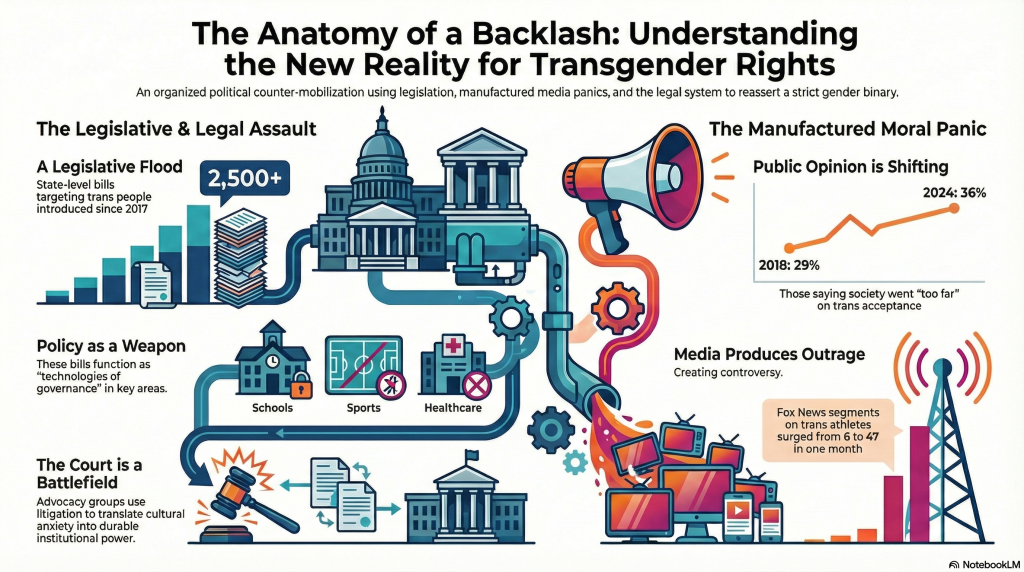
Tracing the recent retreat of the transgender movement requires situating it within a broader reassertion of cisnormative state power and moral panic politics. What’s framed as “debate” is better understood as Political Backlash: an organized counter-mobilization responding to earlier gains in recognition and law. Since 2017, the introduction of more than 2,500 state-level bills targeting transgender people—over 1,000 in a single year—signals not episodic prejudice but a structured project to re-inscribe binary sex as a regulatory norm.
A wave of cisnormative backlash is re-inscribing binary sex as law, policy, and everyday governance.
These bills operate as technologies of governance, translating moral panic into administrative routine. They narrow possibilities for living gender nonconformity by saturating schools, sports, and healthcare with surveillance logics. At the same time, shifting opinion—rising from 29% in 2018 to 36% by 2024 saying society’s gone “too far” in accepting transgender people—shows how discourses of excess and threat legitimate this tightening of control.
Legal Challenges have become both terrain and instrument of rollback. Bostock’s expansive reading of sex discrimination briefly opened doctrinal space, but subsequent retreats, along with Trump-era orders on military service, passports, and federal funding, re-centered state recognition on biological fundamentality. Litigation isn’t neutral; it constitutes gender categories while pretending merely to interpret them.
Media campaigns around trans participation in sports exemplify affective governance. Fox News’s surge from six segments in September 2024 to 47 in October didn’t just reflect concern; it produced it, scripting trans girls as unfair competitors and moral hazards. When state bans on their participation reach the Supreme Court by 2026, the Court adjudicates a controversy it’s helped materialize through its own prior signals about deference to states and tradition.
Conservative legal advocacy groups like Alliance Defending Freedom crystallize these dynamics, turning cultural anxiety into durable institutional power, and pushing the transgender movement from incremental advance into a defensive struggle over basic intelligibility and existence.

 Featured PostsOctober 17, 2026One Step Closer: Trans and Passing
 Featured PostsOctober 14, 2026Navigating Manhood: The Challenges FTM Individuals Face
 Activism and ChangeOctober 14, 2026I’m I7 and Male, I Don’t Know Whether or Not I am a Trans Girl
 Featured PostsOctober 13, 2026A New Beginning: Embracing the Realization That I’m Trans