Trans Chaser 101: From Fetish to Fail

Like a mask that slips under bright light, “trans chaser” behavior reveals desire stripped of respect. You can spot it in fixation on bodies, invasive questions, pressure to disclose, and explicit messages sent without consent. Research on fetishization and harassment shows this behavior doesn’t stay awkward for long; it often turns coercive after rejection and raises real safety risks. If you want to tell attraction from objectification, the difference starts with one hard standard.
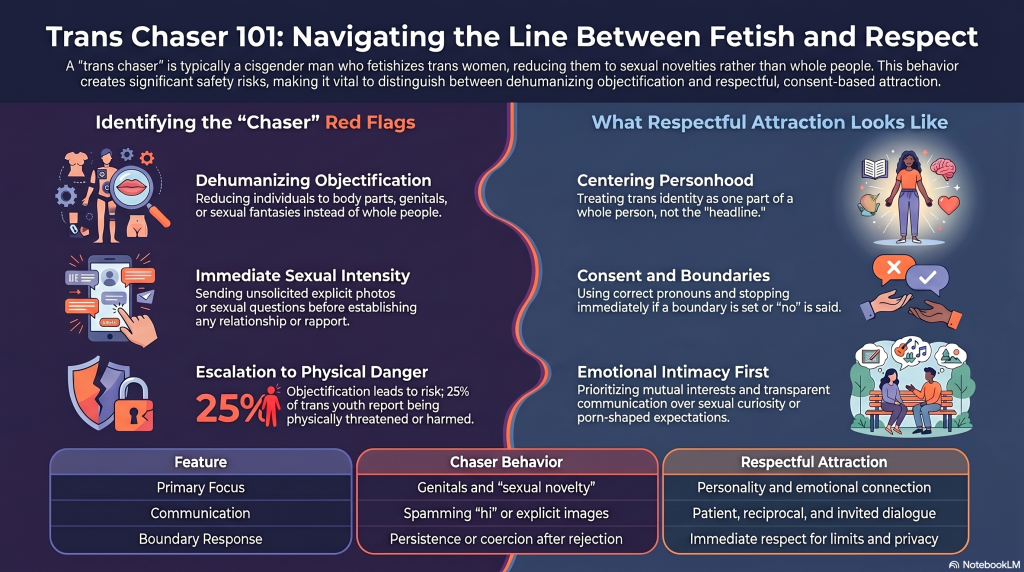
At its core, a trans chaser is someone—most often a cisgender man—who fixates on trans women as a sexual category instead of relating to them as whole people. You can identify the pattern analytically: he reduces a person to body parts, especially genitals, and treats transness as an erotic novelty rather than a lived identity.
Evidence shows this behavior often appears online, where app design enables repeated, low-effort contact and weak moderation lowers consequences. Chasers may pursue trans women while also expressing transphobic ideas, revealing psychological motives rooted in entitlement, stigma, and objectification rather than genuine intimacy. Because public visibility can increase targeting, community responses matter: clearer reporting tools, stronger platform policies, and peer validation help trans women name the behavior, protect boundaries, and reduce isolation and harm generally.

Once you know what a trans chaser is, the next step is recognizing the recurring behaviors that signal objectification rather than sincere interest. You’ll often see intensity without relationship-building: they like every photo rapidly, follow you across platforms, or appear right after a public shift through trans-specific tags.
Their messages also reveal motives. A lone “hi,” immediate sexual questions, or unsolicited explicit images often indicate sexual objectification, not curiosity grounded in respect. Language matters too: fetishizing slurs, fixation on genitals, or treating you like a novelty are strong warning signs, especially when paired with otherwise transphobic attitudes.
Another major red flag is boundary disrespect. If you decline, set limits, or stop responding and they persist, escalate, or push for meetings, they’re showing you that your consent isn’t their priority.

Although chasers often frame their behavior as attraction, the harm comes from reducing trans women to sexual novelty, genitals, and porn stereotypes rather than recognizing them as whole people. When you center someone on labels popularized by porn, you erase personhood and reinforce stigma that already shapes discrimination.
You also create constant harassment: empty DMs, invasive questions, unsolicited photos, and cross-platform pursuit that weak moderation rarely stops. That pressure doesn’t stay online. It feeds economic coercion by exploiting job and housing precarity, pushing some women toward survival sex work, scammers, or coercive arrangements. For newly out people, it creates a disclosure dilemma: disclose and invite fetishists, or stay silent and lose community access. These dynamics intensify dehumanization, isolation, and vulnerability, especially for trans women of color already facing disproportionate violence and partner homicide.
That dehumanization doesn’t stay abstract; it reshapes dating into a constant safety calculation. You’re not just filtering compatibility—you’re managing risk. Chasers often flood your inbox with explicit images, pornified questions, repetitive likes, and persistence after rejection, which increases harassment exposure and emotional strain. Apps can worsen this: searchable tags, rigid categories, and weak moderation make your profile easier to target and harder to protect.
That pressure also distorts disclosure timing. If you disclose on your profile, you may invite immediate chaser attention and nonstop DMs. If you wait until meeting, you may face heightened danger, including violent reactions from partners. For many trans women, especially under economic strain, scammers and fetishizing clients exploit vulnerability too. As a result, dating requires constant safety planning, not just ordinary caution online and offline.
Respectful attraction starts with seeing trans women as whole people, not as categories, fantasies, or access points to specific body parts. You show that by avoiding fetishizing labels, unsolicited anatomy questions, and compliments that make trans status the headline instead of one part of identity.
You also practice consent education: don’t send explicit images, don’t spam DMs, and stop immediately after a clear no. Use correct names and pronouns, and let her disclose on her terms. Build emotional intimacy through mutual interests, honest conversation, and careful discussions about bodies or sex only when invited. Do your homework privately, including learning how discrimination can push some trans women into sexualized visibility. In dating, prioritize safety, communicate transparently, and make her comfort more crucial than your curiosity or fantasy.
You can’t pin down one precise percentage, but evidence suggests only a minority of men are attracted to trans women—about 1–2% report primary attraction, while several percent report occasional interest. Like a town crier announcing nuance, you should note attraction prevalence varies by sexual orientation, stigma, and definitions. You’ll also find dating-app behavior inflates appearances, because many messages reflect fetishizing or harassment, not genuine, respectful attraction or interest.
Trans people don’t like chasers because you reduce them to fetish objectification instead of seeing them as whole people. You often ignore consent, push sexual questions, and create boundary violations that feel invasive and unsafe. Evidence from trans people‘s experiences shows this behavior increases harassment, fear, and emotional harm. If you’re attracted to someone, you need respect, mutuality, and support—not secrecy, entitlement, or porn-shaped expectations that dehumanize them.
Skoliosexual means you’re primarily attracted to trans, nonbinary, or gender-nonconforming people; that’s the skoliosexual definition. In pansexual comparison, you’re attracted to people regardless of gender, so gender doesn’t drive attraction as strongly. You’ll see pansexual used more widely in LGBTQ+ communities, while skoliosexual stays niche. If you use skoliosexual, you should stay mindful: attraction can’t reduce someone to their transness, and respect always matters most.
You don’t follow special “ts dating” rules; you follow respectful dating boundaries and consent norms. You disclose when it feels safest, not on anyone else’s timeline. You screen for red flags like fetishizing messages, invasive anatomy questions, and pressure after rejection. You use apps and communities that affirm your identity. You block, report, and disengage when needed. You protect your energy, set limits clearly, and prioritize your safety over politeness.
You can spot the difference between attraction and fetish when someone treats you as a whole person instead of a category. Research from The Trevor Project found that 1 in 4 transgender and nonbinary young people reported being physically threatened or harmed in the past year, showing how quickly objectification can connect to real danger. When you center consent, respect, and emotional intimacy, you reject chaser behavior and help create dating spaces where trans women’s safety, dignity, and humanity come first.

 News and AdvocacySeptember 5, 2026Administration Move Targets Trans Visibility
 Featured PostsAugust 27, 2026Transgender Identity: Ancient Roots and Modern Understanding
 Featured PostsAugust 27, 2026What Does Non-Binary Mean?
 Featured PostsAugust 27, 2026A Guide to Dating a Trans Woman