Connecting the Dots: Often-Overlooked Signs of Being a Trans Woman

You might not have one clear “I knew” moment. Instead, you may notice quiet patterns: envy that feels like a crush, relief when you imagine being seen as a woman, or private experiments you keep returning to. If you’re autistic or used to masking, those feelings can feel even harder to name. None of this proves anything by itself, but together, the dots may start pointing somewhere you’ve been afraid to contemplate.
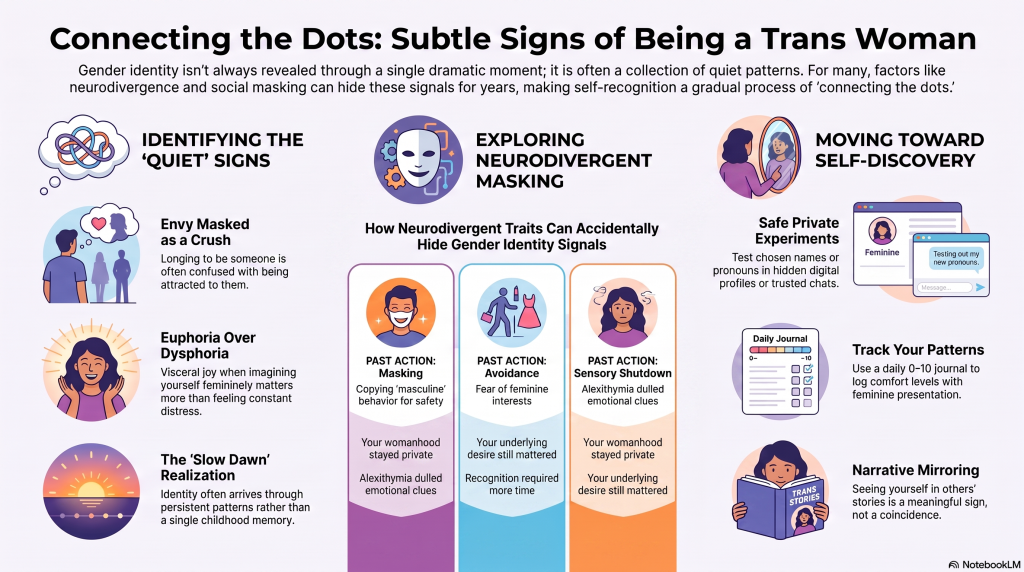
Sometimes the earliest signs that you might be a trans woman don’t look dramatic from the outside; they can feel like quiet, persistent moments of incongruence—wishing you’d been born a girl, feeling vaguely “not like a boy,” or imagining a future where womanhood fits more naturally. You may not have gravitated toward stereotypical “girl” activities, and that doesn’t make your feelings less real. If you’ve spent years masking, dissociating, or struggling to name emotions, you might only recognize these patterns later through quiet reflection. Maybe you kept returning to femme clothes, names, stories, or private experiments that felt strangely right. Over time, these small signals can add up. You don’t need one perfect memory to justify yourself; noticing the pattern is enough to begin listening inward gently.

Often, what feels like an intense “crush” on a feminine-presenting woman may carry another layer: a longing to be like her, move through the world like her, or be seen with the same femininity she embodies. You might notice jealousy, fascination, or a recurring wish for her clothes, curves, makeup, voice, or ease. That doesn’t make your feelings wrong; it may mean attraction and gender longing got tangled.
Gender euphoria can clarify things. If imagining “she,” wearing a skirt, having breasts, or seeing yourself femininely brings relief or visceral joy, listen. Those moments may matter more than who you desire. Track patterns over time: repeated envy, comfort in feminine presentation, and mirror affirmation can point toward a truth you’ve been gently approaching for years.

If gender envy or euphoria felt hard to name, autism may be part of why. Alexithymia can blur body signals, so discomfort, longing, or quiet joy around femininity may not register as gender feelings.
| What you did | Why it hid things | What it may mean |
|---|---|---|
| copied “masculine” behavior | masking kept you safe | your womanhood stayed private |
| avoided feminine interests | fear trained restraint | desire still mattered |
| missed emotions | sensory shutdown dulled clues | recognition took time |
You may have used masked gestures, flattened your voice, or buried softness without choosing to. Later unmasking can reveal posture, mannerisms, skirts, maternal feelings, or fascination with women. None of this makes your path less real; it shows how carefully you survived.
You may recognize yourself only after another trans woman gives language to something you’d carried quietly for years. Maybe early clues felt blurry because you lacked information, masked heavily, or couldn’t name emotions. Then a video, post, or memoir offers relatable visualizations: jealousy toward feminine beauty, confusing attraction with wanting to be her, quiet maternal longing, or subtle childhood incongruence that wasn’t dramatic.
This narrative mirroring can feel startling. Someone describes calm, relief, or tears when others use her name, pronouns, or see her femininity, and your own memories rearrange. Her timeline may also matter: years of masking, signs clustering in adulthood, or a gradual move from non-binary to womanhood. You don’t have to match perfectly. Resonance itself can be meaningful.
After seeing parts of yourself in other trans women’s stories, gentle experiments can help you notice what feels real in your own life. Try private experiments: use a chosen name or she/her pronouns on a hidden profile, or in trusted chats, and notice whether being seen as a woman brings relief or joy.
At home, test clothing, grooming, hairstyles, or makeup. Keep brief notes for several weeks: comfort, dysphoria relief, amplified happiness, or discomfort. A daily 0–10 journal can track patterns and triggers, including media, fantasies, or social moments.
You can also seek peer support in moderated trans, lesbian, bi, or femme spaces while protecting your privacy. A gender-affirming therapist, especially one familiar with autism or alexithymia, can help you understand feelings and consider next steps.
You can’t reliably know if a girl is trans unless she tells you. Don’t guess from gender presentation, voice, body, or interests. If you’re close and it feels relevant, ask respectfully in private, but don’t pressure her to disclose. Notice whether she shares pronouns, name history, or social change details on her own terms. Treat her as the girl she is, protect her privacy, and lead with respect.
Subtle gender dysphoria can feel like your soul hired a tiny fog machine: you’re functioning, but everything’s weirdly muted. You might notice body discomfort, envy of others’ gender expression, relief when imagining different pronouns, or sadness after presenting “correctly.” You may feel social withdrawal, numbness, depression, or sudden joy from small affirming changes. You’re not broken or dramatic; you’re noticing clues. Take your feelings seriously, gently, and investigate safely with support.
A trans woman’s body can look many different ways, and you shouldn’t expect one “typical” appearance. Before puberty, she may look like any girl. After androgen puberty, you might notice broader shoulders or less hip width. With hormone effects, she may develop breasts, softer skin, less body hair, and more hip/thigh fat. Surgical outcomes can change breasts, genitals, or facial features. You’ll best honor her by respecting her womanhood.
Like a compass finding north, you may feel pulled toward womanhood with quiet certainty. You might notice your gender identity through relief, joy, or emotional resonance when others see you as female. You don’t have to feel constant distress; euphoria matters too. You may also feel longing, envy, recognition, or peace imagining life as a woman. Your feelings are valid, and you’re allowed to investigate them gently.
You don’t need one thunderclap moment to prove who you are. Sometimes truth arrives like dawn—slow, soft, and undeniable. If you’ve felt gender envy, quiet longing, hidden relief, or recognition in other trans women’s stories, listen with kindness. Autism, masking, or fear may have muffled the signal, but they don’t erase it. Investigate safely, at your pace. You’re not wrong for wondering. You’re allowed to follow the light toward yourself.

 Featured PostsOctober 17, 2026One Step Closer: Trans and Passing
 Activism and ChangeOctober 14, 2026I’m I7 and Male, I Don’t Know Whether or Not I am a Trans Girl
 Featured PostsOctober 13, 2026A New Beginning: Embracing the Realization That I’m Trans
 Featured PostsOctober 13, 2026Colorado and Michigan Join States Ending Medicaid Coverage for Trans Youth