The Best Places to Be You: Exploring the World’s Most Pro-LGBTQ+ Cultures

You might dream of a single “safest” haven for LGBTQ people, yet the reality is a patchwork of laws, attitudes, and lived experiences that rarely align neatly. When you compare countries like Iceland, Malta, Canada, and the Netherlands, you’re weighing marriage equality, hate-crime enforcement, trans healthcare access, racial justice, and public opinion data all at once. The real question isn’t just where you’re protected on paper—but where you’re truly able to live.
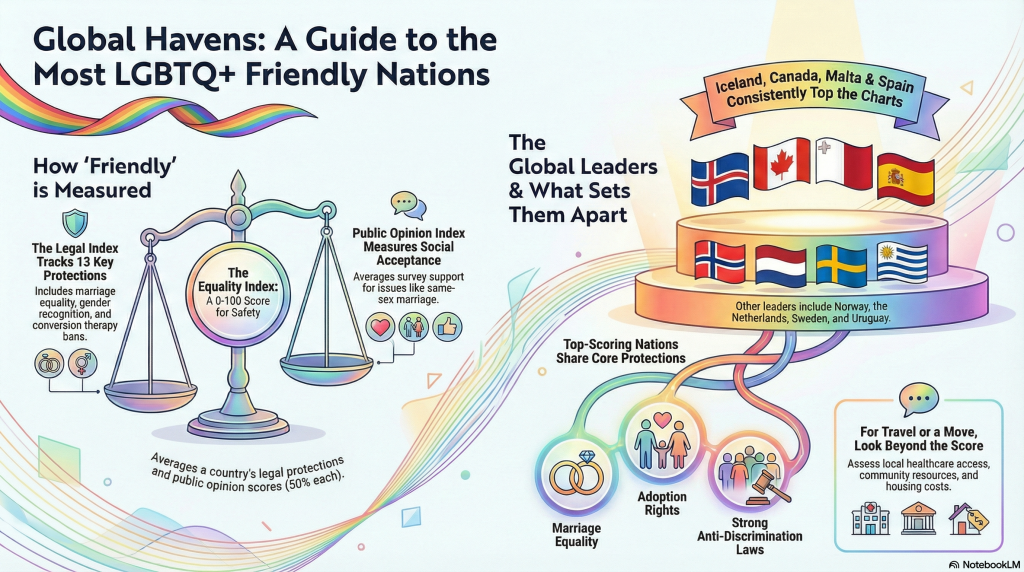

When you look at global equality indices, a clear pattern emerges: countries like Iceland, Norway, the Netherlands, Sweden, and Canada routinely sit at the top because they combine robust legal protections with high social acceptance of LGBTQ people. You observe this in full marriage equality, protections for same sex parenting and adoption, and strong anti-discrimination and hate‑crime laws.
Malta, Spain, and Uruguay join that leading tier by pairing marriage and adoption rights with bans on conversion therapy and, in Malta’s case, protections for intersex people. Portugal, Iceland, and Malta also stand out for progressive gender recognition.
Australia, New Zealand, and much of Western Europe add vibrant queer nightlife and visible public culture to these legal baselines, reinforcing everyday safety and inclusion.

To move from naming LGBTQ-friendly countries to understanding why they rank so highly, you need a clear, transparent scoring framework. You start with the Equality Index: a 0–100 score that averages a Legal Index and a Public Opinion Index, each weighted 50%. This balance lets you compare what’s on paper with what people actually believe.
The Legal Index scores 13 areas—decriminalization, partnership rights, parenting, gender recognition, hate‑crime and anti‑discrimination protections, conversion‑therapy bans, military service, and youth education safeguards—using weighted 0–100% scores. You exclude unknowns so missing data doesn’t punish countries, reinforcing policy transparency.
The Public Opinion Index averages survey support (like same‑sex marriage), downweighting older polls about 25% per year. Raw, continuously updated scores let you track intersectional legal and attitudinal change in real time.

Although no single number can capture lived experience, the Equality Index shows that LGBTQ safety consistently rises where robust laws and broad public support move in tandem. When you’re in a country like Iceland or Spain, high Legal and Public Opinion scores usually mean fewer hate crimes, better healthcare access, and more positive media representation.
You also see how gaps emerge. A state can criminalize anti-LGBTQ violence yet deny adoption or gender-recognition rights, producing uneven safety by sexuality, gender identity, and family status. Where laws advance faster than attitudes, you may face hostility despite formal protections. Where public opinion leads, daily life can feel safer even while statutes lag. Because surveys are time‑weighted, rapid shifts in acceptance reshape risk in just a few years.
Across the globe, several regions are posting some of the steepest gains on the Equality Index, reshaping what safety and inclusion look like for LGBTQ people across class, race, and migration status. As evidenced this clearly in Australia and New Zealand, where marriage equality and protections for gender-affirming care reflect rapid Legal innovations backed by strong health systems.
Nordic countries like Iceland, Norway, and Sweden pair top scores with bans on conversion therapy and self-determined gender recognition, signaling durable policy change. Western Europe’s leaders—Malta, Belgium, Spain, Portugal—layer adoption, intersex safeguards, and robust anti-discrimination laws. In South America, Uruguay and neighbors advance family rights and workplace protections. Meanwhile, in parts of Africa, Asia, and the Caribbean, Community initiatives and shifting attitudes often move faster than the law.
Rapid progress in places like Iceland, Malta, and Uruguay isn’t just a policy story; it’s a practical roadmap for where you can actually live, work, or travel with safety and dignity. To choose a place, you’ll want to combine legal, social, and economic data, not vibes alone.
1. Score the laws and public attitudes.
Prioritize Equality Index leaders like Iceland, Norway, Spain, and Uruguay, plus countries with marriage, joint adoption, and hate‑crime protections such as Malta, the Netherlands, and Canada.
2. Check services and community resources.
Confirm gender‑affirming care, legal gender recognition, and local LGBTQ centers or Pride.
3. Assess lived reality and housing affordability.
Compare hate‑incident rates, Global Acceptance Index data, housing costs, and visa options in cities like Amsterdam, Madrid, Toronto, and Reykjavík.
You can’t reliably name one country with the most LGBTQ people because demographic surveys rarely track identity consistently. Instead, you’ll see large countries like the United States, Brazil, and India likely hosting the biggest absolute numbers. Where policy protections, funding for community centers, and anti-discrimination laws exist, more people safely self-identify. Intersectional factors—race, class, migration status—also shape who appears in the data and who stays invisible.
You’ll find the safest options in places like Malta, the Nordic countries, the Netherlands, Canada, and New Zealand. You get strong legal protections, robust enforcement mechanisms, and universal healthcare access including gender‑affirming care. Anti discrimination laws cover work, housing, and services, helping guarantee safe housing. High social acceptance, visible community centers, and cultural inclusion policies support you, especially if you’re LGBTQ and also marginalized by race, migration status, or disability.
You won’t find a single “LGBTQ capital,” because data, laws, and lived experience vary. You’ll likely compare Reykjavik, Amsterdam, Madrid, San Francisco, and Tel Aviv. Each offers strong protections, visible Pride tourism, and dense queer nightlife, but with different policy gaps on trans rights, migrants, and racialized communities. You should map legal equality, hate‑crime stats, healthcare access, and affordability before deciding which city best fits your intersecting identities.
Yes, you’ll generally find Canada more LGBTQ-friendly than the US. You get nationwide marriage equality, explicit federal protections, a conversion-therapy ban, and more consistent healthcare access, including gender-affirming care. Political representation and public opinion skew more reliably pro-LGBTQ across provinces. In the US, your rights, safety, and services depend heavily on state and local laws, creating sharper disparities, especially for trans people and LGBTQ people of color.
You’ve seen the rankings, the legal checklists, the rising public support. You know Iceland, Malta, Canada, the Netherlands, and others keep topping the charts—with marriage equality, gender-recognition laws, hate-crime protections, and conversion-therapy bans. But your most LGBTQ‑friendly country isn’t just a score; it’s where policy, culture, race, class, and disability protections intersect for you. So you’ll compare indexes, read local reports, talk to queer residents—and then decide where your safety, rights, and joy align.

 News and AdvocacySeptember 5, 2026Administration Move Targets Trans Visibility
 Featured PostsAugust 27, 2026Transgender Identity: Ancient Roots and Modern Understanding
 Featured PostsAugust 27, 2026What Does Non-Binary Mean?
 Featured PostsAugust 27, 2026A Guide to Dating a Trans Woman