Beyond Pink and Blue: Understanding What Gender Really Means

You encounter gender every day through names, pronouns, forms, policies, and assumptions. To understand gender identities and pronouns, you need to distinguish identity from sex assigned at birth and sexuality, while recognizing each person’s authority over their own experience. When you use someone’s chosen name and pronouns, you do more than follow etiquette; you shape whether a space feels safe, credible, and respectful—and that raises a significant question.
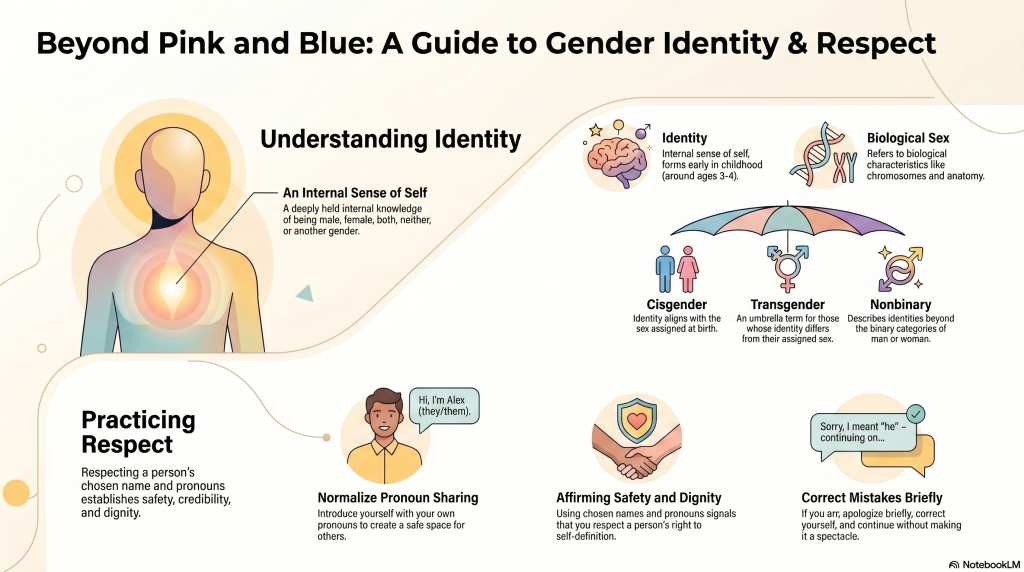
Gender identity describes a person’s deeply held internal sense of being male, female, both, neither, or another gender. You can understand it as an inward self-knowledge that often begins forming around developmental stages three to four, alongside early developmental milestones in self-recognition, language, and social awareness. As you examine gender identity, you should account for cultural influences: families, communities, media, religion, and institutions shape the labels, expectations, and possibilities people encounter, but they don’t simply determine someone’s identity. Many people experience their gender as consistent over time; others notice shifts as they gain vocabulary, safety, or insight. You should also recognize that identities can be binary or nonbinary, including agender or genderfluid experiences. Respecting someone’s stated name and pronouns affirms their dignity and supports well-being.

Although people often use sex, gender identity, and sexuality as if they mean the same thing, each term describes a different aspect of human experience. You can understand sex as biological characteristics: chromosomes, gonads, hormones, and anatomy, usually categorized as male, female, or intersex, though bodies don’t always fit XX/XY expectations. Gender identity refers to your internal sense of self, which may emerge early through brain development and continue changing across life. Sexuality, or sexual orientation, concerns enduring emotional, romantic, or physical attraction. You should also distinguish gender expression—clothing, voice, or behavior—from identity and orientation. Socialization patterns can shape how you present yourself, especially across cultures or safety contexts, but they don’t determine who you are, whom you’re attracted to, or your biology.

As you encounter language around identity, it helps to treat terms as tools for self-description rather than fixed boxes. You’ll see cisgender, or cis, used when someone’s gender identity aligns with the sex assigned at birth. Transgender, or trans, names an umbrella category for people whose identity differs from that assignment. Nonbinary describes identities beyond only man or woman, including genderqueer, agender, bigender, and genderfluid.
You should distinguish intersex from gender identity: intersex refers to anatomical, chromosomal, or hormonal sex characteristics that don’t fit typical male or female categories. More specific terms map varied experiences: genderfluid can shift; agender means no gender; demigirl or demiboy indicates partial identification; bigender indicates two genders. Gender expression may differ from identity, so sound pronoun etiquette begins with recognizing self-defined terms.
Using someone’s chosen name and pronouns signals that you recognize their self-identified gender and their right to define how others address them. You can normalize this practice by introducing yourself initially: “I’m Alex, and my pronouns are they/them.” Ask names, pronouns without presuming from appearance, records, or past usage. Use the full set provided, such as she/her, he/him, or they/them/theirs, and apply correct agreement: “They are.” If you err, apologize briefly, correct yourself, and continue; extended explanations shift attention away from the person addressed. Include signatures, pronouns in email blocks, name tags, and meeting introductions to reduce institutional assumptions. Because context can affect safety, follow the person’s current stated preference in each setting, even when it differs across spaces.
Respect starts with taking someone’s gender at face value and acting on what they tell you. Introduce your pronouns initially, then ask for their stated name and pronouns without pressure. If you err, say, “Sorry, Alex, they/them,” and continue; repair matters through consistency, not spectacle.
| Practice | Why it matters | Your action |
|---|---|---|
| Pronouns | Reduces assumptions | Use she/her, he/him, they/them, xe/xem |
| Privacy | Protects safety | Don’t out anyone |
| Language | Prevents harm | Say “transgender person,” not slurs |
Strong affirmation practices include chosen names, record updates, and gendered spaces aligned with comfort. Respect privacy boundaries by asking sensitive questions only with consent. You can model inclusive language and share resources, such as The Trevor Project or local trans support groups.
Yes, your gender identity can change over time. Imagine one survey where about 3% of adults report a gender identity different from their sex assigned at birth, reflecting real diversity. You may experience gender fluidity as feelings, language, or self-understanding shift. Through identity development, you actively interpret your body, culture, relationships, and inner sense of self. Such change doesn’t make your identity less valid; it shows human complexity.
Neopronouns work like any pronouns: you use them to refer to someone respectfully in place of a name. You might say, “Xe is presenting xeir research,” if that person uses xe/xem. These invented pronouns require conversational practice because unfamiliar forms can feel awkward at to begin with. You can normalize them by asking, listening, correcting yourself briefly, and continuing. You’re supporting precise self-reference, social recognition, and inclusive communication.
Yes, you can include pronouns in your email signature if it feels authentic and useful. You create clarity benefits by helping colleagues address you accurately and reducing assumptions. You should also weigh professional considerations, including workplace culture, client expectations, and personal safety. Don’t feel obligated; disclosure remains your choice. When you include pronouns, use a simple format, such as “Pronouns: she/her,” alongside your name, title, and contact information.
Laws shape how you change gender markers by setting eligibility rules, evidence standards, and agency procedures. You may face legal barriers like court orders, medical certification, residency requirements, or limited nonbinary options. You’ll also weigh documentation costs for amended IDs, passports, birth certificates, and legal filings. These rules can affect privacy, safety, employment, healthcare access, and recognition, so you should review local requirements and seek supportive legal guidance.
You should build safe, affirming schools by adopting inclusive policies that protect names, pronouns, privacy, facilities access, and participation in activities. You’ll also strengthen practice through staff training, so educators identify harassment, respond consistently, and support student well-being. You should involve students and families, review data on discipline and bullying, and guarantee counseling access. These steps reduce exclusion, improve belonging, and promote equitable learning for transgender students every day.
You deepen dignity when you recognize gender as personal, plural, and possibly changing. By separating identity from sex and sexuality, you build clearer, kinder understanding. When you use chosen names and pronouns, ask respectfully, and correct mistakes briefly, you practice purposeful, protective support. You don’t need perfection; you need patience, privacy, and principled care. Through thoughtful language and steady solidarity, you help shape safer spaces where every person’s identity can be seen, respected, and sustained.

 Featured PostsOctober 21, 2026The Trans Journey to Passing
 Featured PostsOctober 17, 2026One Step Closer: Trans and Passing
 Featured PostsOctober 14, 2026Navigating Manhood: The Challenges FTM Individuals Face
 Activism and ChangeOctober 14, 2026I’m I7 and Male, I Don’t Know Whether or Not I am a Trans Girl