More Than a Label: Understanding the Meaning and Origins of Two-Spirit

If you’ve heard “Two-Spirit” used like a generic LGBTQ+ label, you’re not getting the full story. You’re looking at a term shaped in 1990 at the Native American Gay and Lesbian Gathering, drawn from Anishinaabe language, and tied to specific nations’ roles, responsibilities, and spiritual frameworks. You can’t separate it from colonial disruption or pan-Indigenous flattening. So who can claim it today, and what does respectful use actually require?
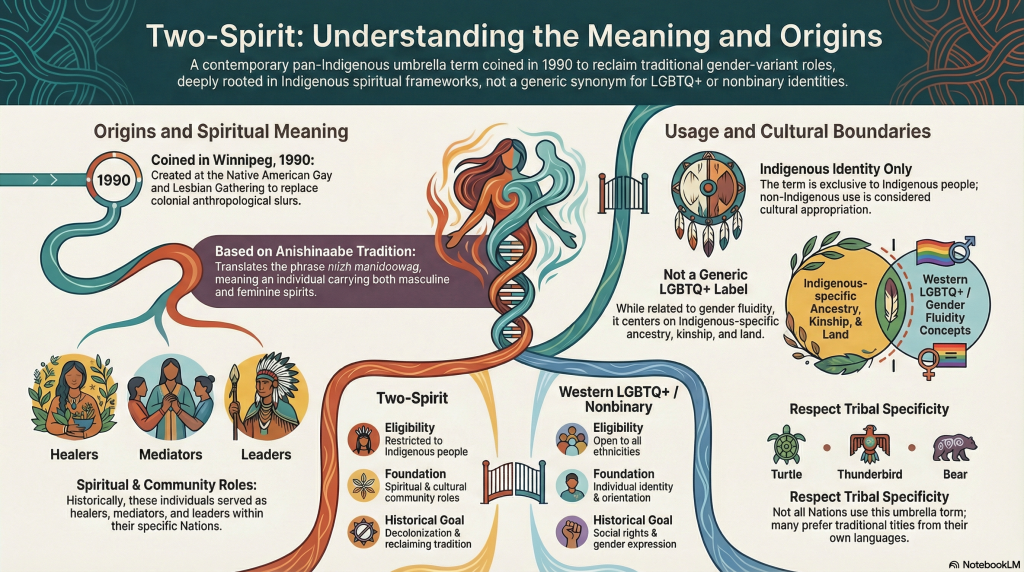

A bridge—not a label you can casually swap in—best describes what “Two-Spirit” means. You’re naming a contemporary umbrella term, coined in 1990 at intertribal gatherings, that translates Anishinaabe niizh manidoowag, “two spirits.” It points to Indigenous people understood as carrying both masculine and feminine spirits, and it centers Cultural significance and Spiritual connections within specific nations, not a generic gender category.
You also need to know what it doesn’t mean. It isn’t a simple synonym for non-binary, gay, or transgender, and it doesn’t map neatly onto Western identity frameworks. You use it to reclaim identities targeted by colonization and to replace slurs like “berdache.” Still, you shouldn’t assume every community accepts it or lacks its own terms.
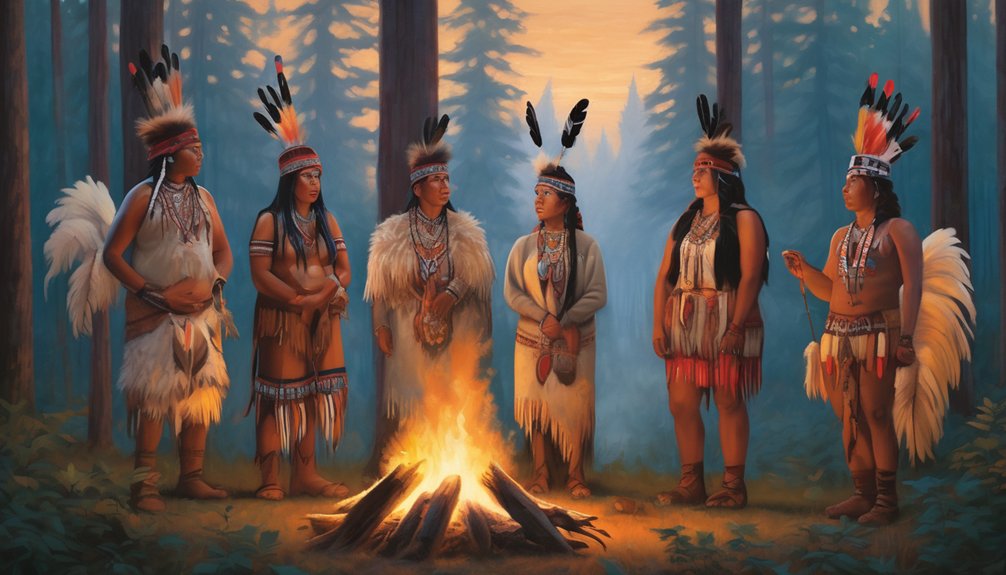
So who can claim Two-Spirit today? You can only use it if you’re Indigenous, because it’s tied to Indigenous Identity and to responsibilities, kinship, and community roles shaped within specific Nations. If you’re non-Indigenous, using it turns a lived, colonially targeted history into a costume, even if your gender feels “both” or outside binaries.
If you’re Indigenous and LGBTQIA+, you might choose Two-Spirit when it fits your mixed-gender consciousness and your relationship to community. Still, you don’t have to adopt it: many Nations hold their own language and teachings for gender-variant roles, and those may not map neatly onto this umbrella term. Your choice should honor Cultural Significance, local protocol, and the realities colonization created across communities today.

When Indigenous LGBTQ+ leaders gathered in Winnipeg for the 1990 Native American Gay and Lesbian Gathering, they intentionally coined “Two-Spirit” to name identities and roles that colonial language had distorted or erased. You can trace this cultural reclamation to Cree activist Myra Laramee, who предложила the term by translating the Anishinaabe phrase *niizh manidoowag* (“two spirits”). Together, participants sought a respectful pan-Indigenous umbrella for people recognized in their nations as embodying both masculine and feminine qualities, without flattening tribal specificity. They also meant to replace “berdache,” a slur rooted in colonial anthropology. The name didn’t appear in isolation: it grew from ongoing conversations across Indigenous-led conferences, grounding identity formation in community recognition rather than Western binaries.
Coining “Two-Spirit” in 1990 didn’t just replace a colonial slur—it also set boundaries around what the term means today, especially alongside labels like nonbinary and LGBTQ+. When you use Two-Spirit, you’re pointing to Cultural significance tied to Indigenous nations, not only to Gender fluidity. It’s an umbrella for people understood to hold both masculine and feminine spirits, with responsibilities that can include Spiritual roles in community life.
Nonbinary can describe gender outside man/woman across many cultures, but it doesn’t require Indigenous heritage or the same Historical context. LGBTQ+ terms can stand apart from ancestry, while Two-Spirit centers reclaiming Indigenous gender systems suppressed by colonization. You’ll also notice acceptance varies by nation and community, not uniformly.
Although “Two-Spirit” emerged in 1990 as a reclaiming, decolonial umbrella for Indigenous people whose genders and community roles don’t fit colonial binaries, it remains debated because not every Nation uses it—or wants a pan-Indigenous label to stand in for their own specific teachings and terms. Some communities hold distinct names, roles, and responsibilities that a single term can blur, so you shouldn’t treat “Two-Spirit” as interchangeable with nonbinary or LGBTQ+ categories.
To use it respectfully, you ground it in history: colonization targeted gender-variant roles, and communities still rebuild those teachings. You also avoid cultural appropriation: if you aren’t Indigenous, don’t claim it. Ultimately, watch identity politics—don’t demand the label, police who “counts,” or erase specificity. Ask people what they use, and follow their Nation’s protocols.
Like a braid of two strands, Two-Spirit originated in 1990 at an intertribal Indigenous LGBTQ+ conference in Winnipeg. You can trace it to the Anishinaabe phrase *niizh manidoowag* (“two spirits”), and you should read it through cultural significance and historical context: it arose as a decolonial, evidence-based response to colonial suppression and slurs like “berdache.” You’ll also find communities vary in acceptance and keep distinct traditional terms.
No, “Two-Spirit” isn’t the same as LGBTQ+. You use LGBTQ+ to describe broad sexual orientation and gender identities, mostly shaped in Western contexts. You use Two-Spirit as an Indigenous-specific Identity expression with deep Cultural significance tied to community roles, land, and kinship, and it emerged as a contemporary umbrella in 1990. You shouldn’t assume every Nation uses it; many hold distinct terms and teachings.
You can’t name “the 5 genders of Native Americans” because genders vary by tribe and time. Over 570 federally recognized U.S. tribes exist, so gender diversity doesn’t fit one fixed list. Many communities recognize male and female roles plus supplementary identities, including Two-Spirit and specific third-gender roles like Lakota Winkté or Navajo Nádleehi. You should treat each term’s cultural significance locally and avoid pan-Indian labels.
Two-Spirit spiritual means you hold a spiritual identity that integrates masculine and feminine spirits within an Indigenous worldview. You don’t just describe gender expression; you connect spirituality, community responsibilities, and kinship. Evidence from many Nations shows Two-Spirit people historically served as healers, mediators, and leaders, giving the role deep cultural significance. You should treat it as Indigenous-specific, not a Western LGBTQ+ substitute, and respect Nation-specific teachings.
When you hear “Two-Spirit,” you’re not just learning a new identity word—you’re being asked to see Indigenous nations’ living teachings, responsibilities, and kinship roles that colonialism tried to erase. It isn’t a catch‑all for nonbinary or LGBTQ+; it’s a specific, community-rooted term shaped in 1990 to reclaim what was already there. So, before you apply it, ask yourself: whose story are you honoring? Listen, learn, and follow protocol.

 Featured PostsOctober 17, 2026One Step Closer: Trans and Passing
 Activism and ChangeOctober 14, 2026I’m I7 and Male, I Don’t Know Whether or Not I am a Trans Girl
 Featured PostsOctober 13, 2026A New Beginning: Embracing the Realization That I’m Trans
 Featured PostsOctober 13, 2026Colorado and Michigan Join States Ending Medicaid Coverage for Trans Youth