The Price of Safety: Fleeing Anti-Trans Laws in the Lone Star State

When you hear about a Houston family spending $20,000 to uproot their life so their trans teen can keep hormone therapy, you start to grasp how safety comes with a price tag. You’re not just weighing politics; you’re calculating lost income, fractured co‑parenting, disrupted care, and the risk of staying in a state that’s rewriting what “sex” means in law and medicine. The question becomes not just if you can leave, but what it costs you to stay.
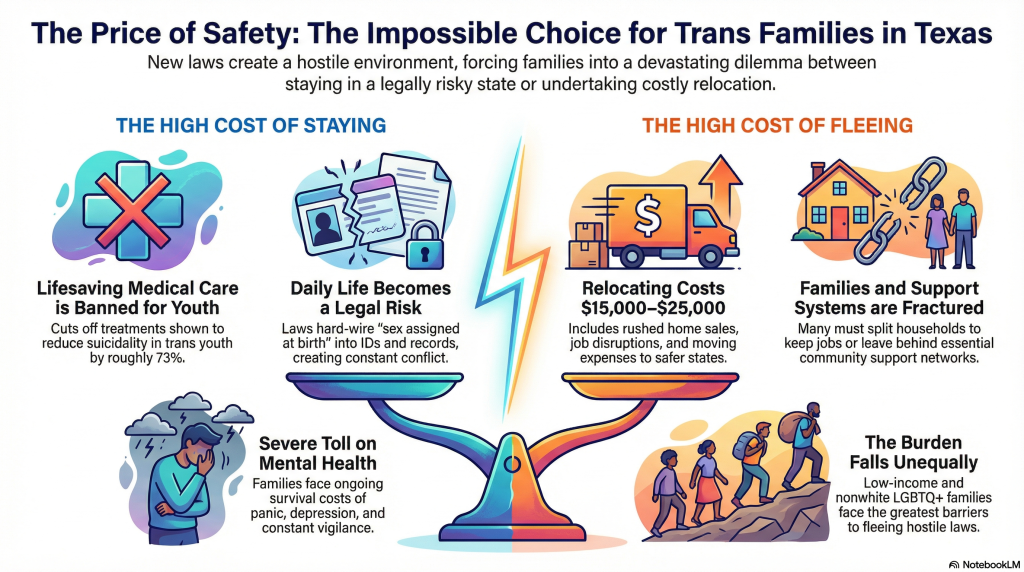

Even if the statutory language sounds technical, Texas’s new laws don’t just define “sex” on paper; they hard‑wire a narrow, biology‑only definition of “man” and “woman” into nearly every interaction you have with the state. Under HB 229, the legal definitions of “woman” and “man” hinge entirely on reproductive anatomy, not identity or lived reality. That ripples into ID renewals, where a gender marker you already changed may be yanked back.
You feel the social implications everywhere: at the DPS counter, in a courthouse, applying for state services. When law says you’re one thing and your life says another, every document becomes a potential site of conflict, outing, or denial—by design, not accident.

While Texas officials defend these laws as “clarifying” data and protecting patients, the new rules around medical records, technology, and insurance instead lock your assigned sex at birth into the core of your health care and financial risk. SB 1188 hard-codes that designation in every state medical record, tightly restricts edits, and threatens civil penalties, heightening provider liability if anyone tries to correct or respect your lived gender.
Because gender identity entries are optional, many clinicians may omit them altogether. HB 229’s rigid definitions of “man” and “woman” then echo through every form and database, undermining your data sovereignty. Added server-location and AI restrictions further burden access, while SB 1257 pressures insurers to drop gender-affirming care coverage rather than fund detransition care.

Although state leaders frame these measures as protecting children, Texas has instead built a legal maze that targets trans and gender‑nonconforming youth at nearly every point of care. When the state banned medical gender‑affirming care for minors and the Supreme Court upheld it, you lost access to treatments shown to cut suicidality by roughly 73%. HB 18 then narrowed Mental health access, blocking rural counseling if it’s “inconsistent” with your sex assigned at birth, even though earlier bans didn’t touch therapy.
Texas has weaponized healthcare law, cutting off lifesaving support for trans and gender‑nonconforming youth
As Texas lawmakers shift their focus from clinics to classrooms, the state’s schools and libraries are becoming another front where your existence is pushed out of view. Under Senate Bill 12, teachers can’t mention sexual orientation or gender identity, and student clubs “based on” those topics—like GSAs—disappear. You lose structured spaces where allies and peers once helped counter student isolation.
Senate Bill 13 deepens that erasure through library censorship. New local councils can strip shelves of books that don’t match “community values,” a standard often weaponized against LGBTQ+ titles and trans narratives. Even failed efforts to ban drag story hours signal which stories lawmakers consider unacceptable. Combined with restroom and sports restrictions, daily school life quietly rewrites you out of the period.
Even before you pack a single box, the decision to stay in Texas or leave it for your child’s safety demands a kind of triage most families never expect to face. You’re weighing relocation tradeoffs: $15,000–$25,000 moves to Colorado or Minnesota, selling a house fast, or splitting your household so one parent keeps a job. You leave behind schools and neighbors that once felt like home.
If you stay, the hidden survival costs mount: panic attacks, depression, disrupted medical care, constant vigilance for CPS at the door. Data and advocates warn that low‑income and nonwhite LGBTQ+ families bear the harshest constraints while wealthier, often white families flee.
You won’t find any U.S. state where misgendering’s broadly “illegal,” yet you will find places where it’s treated as civil harassment. In states like California, New York, Oregon, Colorado, and Washington, repeated, intentional misgendering tied to bathroom access or employment discrimination can violate gender-identity protections. You move between jurisdictions that affirm your identity on paper and others that ignore it, exposing how “rights” depend on ZIP code.
You won’t find a single “safest” state, but Massachusetts, California, and Colorado consistently rank at the top for LGBTQ+ protections. You’ll see strong nondiscrimination laws, better healthcare access (including gender‑affirming care), and robust school policies. Oregon, Vermont, and New Jersey also stand out. Still, you can’t rely on laws alone—you’ll want active LGBTQ+ community centers, local ordinances, and real enforcement to feel genuinely safe day‑to‑day.
Yes, in Texas you now walk under locked skies: HB 229 and SB 1188 effectively ban changing gender markers on most state and medical records. You face new legal challenges, as providers risk civil penalties for updating documents. Medical access can suffer when records misgender you, chilling honest disclosure and care-seeking. Critics argue these laws weaponize paperwork, erase lived realities, and push you to choose between safety, accuracy, and remaining in Texas.
You’ll find the strongest trans rights protections in states like California, New York, Oregon, Washington, and Colorado. They include explicit workplace protections, housing and public-accommodation safeguards, and increasingly robust trans inclusive healthcare, especially for youth. These states often let you change gender markers on IDs without surgery. Still, protections vary even within states, so you’ll need to check both state law and local ordinances to understand your actual safety net.
You’re like a family packing a $20,000 U‑Haul not for a dream but for escape, knowing every mile buys a little safety and sells a lot of home. Whether you stay or leave, you’re paying—through fractured care, erased records, lost jobs, or chronic fear. When the state rewrites “sex” in its own image, your body becomes a battleground; insisting on your reality becomes both resistance and survival.

 Featured PostsSeptember 5, 2026Administration Move Targets Trans Visibility
 Featured PostsAugust 27, 2026Transgender Identity: Ancient Roots and Modern Understanding
 Featured PostsAugust 27, 2026What Does Non-Binary Mean?
 Featured PostsAugust 27, 2026A Guide to Dating a Trans Woman