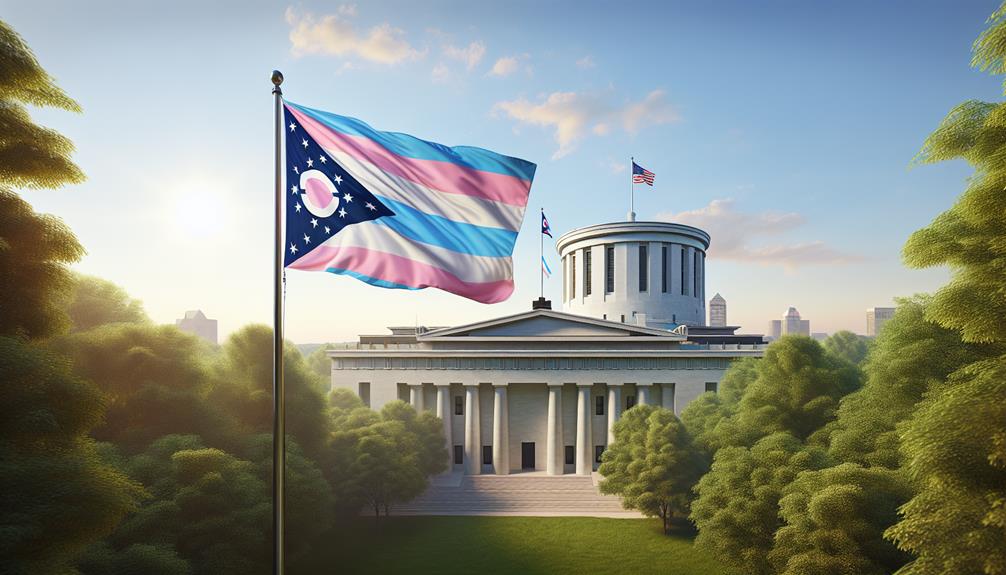
The transgender state of affairs in Ohio is a tumultuous mix of progress and regress, raising questions about rights and well-being - a complex and evolving landscape.
0:00
Like a pendulum swinging between progress and regress, the state of affairs for transgender individuals in Ohio is a complex tapestry of legal, social, and personal challenges.
Recent legislative developments have sparked intense debates and raised concerns about the rights and well-being of transgender people in the state.

Amidst this backdrop of uncertainty and change, a multitude of perspectives and experiences come into play, shaping the current landscape for transgender individuals in Ohio.
Key Takeaways
- Ohio has implemented a ban on gender-affirming medical care for transgender minors, including surgeries, hormone therapies, and mental health care.
- The legislation also prohibits transgender girls and women from participating in sports teams at K-12 and collegiate levels.
- Families of transgender children in Ohio are concerned about limited access to gender-affirming care, leading some to contemplate relocating to other states.
- Transgender individuals in Ohio lack explicit legal safeguards for their rights, impacting employment opportunities and extracurricular activities, and raising concerns about access to necessary gender-affirming care.
Legal Landscape for Transgender Rights
The legal landscape for transgender rights in Ohio has recently undergone significant changes, impacting access to gender-affirming care and participation in sports for transgender individuals.
Ohio Senate's recent decision to override the governor's veto on banning gender-affirming care for minors has sparked widespread debate. This ban encompasses surgeries, hormone therapies, and mental health care for transgender individuals under 18. The law is expected to take effect in approximately 90 days, aligning Ohio with at least 23 other states with similar bans on gender-affirming medical care for transgender minors.
Furthermore, Ohio's new legislation also prohibits transgender girls and women from participating in sports teams at K-12 and collegiate levels, in line with approximately 20 other states with comparable bans.
Families of transgender children in Ohio are deeply concerned about the potential lack of access to gender-affirming care and are contemplating moving out of state to ensure their children receive necessary treatments. Meanwhile, LGBTQ+ advocates, including Equality Ohio, are exploring legal and legislative avenues to safeguard the rights of transgender residents and their families.
Simultaneously, the Biden administration is working on a proposal to prohibit outright bans on transgender athletes, citing violations of Title IX.
Healthcare Access and Challenges
Governor DeWine's executive order banning gender-affirming surgeries for individuals under 18 has raised concerns among LGBTQ+ advocates and healthcare professionals in Ohio. The Ohio Senate's decision to override the Governor's veto on the ban of gender-affirming care for minors has sparked widespread worry.

This ban encompasses surgeries, hormone therapies, and mental health care for transgender individuals under 18. With Ohio set to join at least 23 other states with similar bans, families of transgender children in Ohio are apprehensive about the limited access to gender-affirming care. Some are even contemplating relocating to other states to ensure their children receive the necessary treatments.
The executive order signed by Governor DeWine, which was previously vetoed, has disappointed LGBTQ+ advocates. Furthermore, it has prompted Democrats and LGBTQ+ advocates to consider legal and legislative options to safeguard transgender residents and their families. The uncertain legal landscape, with mixed rulings in other states, adds to the complexity of the situation.
As a result, there's a pressing need for dialogue and action to address the healthcare access and challenges faced by transgender individuals in Ohio.
Employment and Workplace Protections
Transgender individuals in Ohio face challenges in accessing employment and workplace protections due to the absence of explicit legal safeguards for their rights. The current state laws have garnered attention and concern, including a recent legislation that overrides the governor's veto to ban gender-affirming care for minors, encompassing surgeries, hormone therapies, and mental health care. Additionally, the state law prohibits transgender girls and women from participating in girls' and women's sports teams at both K-12 and collegiate levels, impacting their opportunities for extracurricular activities and potential scholarships. Families of transgender children in Ohio are worried about the potential lack of access to necessary gender-affirming care, with some even considering relocating to other states for treatment. Governor DeWine's executive order banning gender-affirming surgeries for individuals under 18 has caused disappointment and concern among LGBTQ+ advocates. Legal challenges and advocacy efforts are being explored to protect transgender residents and their families, mirroring similar actions in other states facing comparable bans on gender-affirming care for minors.
| Concerns | Impact |
|---|---|
| Lack of legal safeguards | Limited employment protections for transgender individuals |
| Restrictions on sports participation | Impacted opportunities for extracurricular activities and potential scholarships |
| Potential need for relocation | Concerns about access to necessary gender-affirming care |

Discrimination and Safety Concerns
Amidst ongoing debates and legislative actions, concerns about discrimination and safety for transgender individuals in Ohio have gained heightened attention and scrutiny. The state legislature's recent actions have sparked significant debate and raised safety concerns for the transgender community. The ban on gender-affirming care for minors, including surgeries, hormone therapies, and mental health services, has created a contentious and potentially unsafe environment for transgender youth.
Additionally, the new law restricting transgender girls and women from participating in girls and women's sports teams has raised fears of further marginalization and discrimination.
Governor DeWine's veto of the legislation was aimed at protecting parents and children from potential government overreach. However, LGBTQ+ advocates and Democrats argue that the legislation could lead to increased discrimination and safety concerns for transgender individuals. The clash between legislative actions and executive orders has created an environment of uncertainty and fear within the transgender community in Ohio.
As the state grapples with these ongoing issues, the safety and well-being of transgender individuals remain a critical point of concern and contention.
Community Support and Activism
Community organizations and allies are rallying to provide support and advocacy for transgender individuals facing legislative challenges in Ohio. In the wake of the Ohio Senate's vote to override the Governor's veto on banning gender-affirming care for minors, the transgender community in Ohio has encountered significant obstacles.
In response to this, various initiatives and actions have emerged to address the situation:
- Legal and Legislative Advocacy
Advocates are planning to explore legal and legislative options to protect transgender residents and their families. This may involve challenging the bans through the legal system and advocating for inclusive laws that support transgender rights.
- Healthcare Access
Proposed administrative rules in Ohio may restrict transgender healthcare for adults. Community organizations and allies are working to ensure that transgender individuals have access to necessary healthcare, including gender-affirming surgeries, hormone therapies, and mental health care.

Community support and activism are crucial in safeguarding the rights and well-being of transgender individuals, especially minors, in Ohio. As the state grapples with legislative challenges, these efforts aim to create a more inclusive and supportive environment for the transgender community, addressing issues related to healthcare, sports, and youth.
Frequently Asked Questions
What Specific Laws and Policies Are in Place to Protect the Rights of Transgender Individuals in Ohio?
In Ohio, specific laws and policies protect the rights of transgender individuals. These include anti-discrimination laws in housing, employment, and public accommodations.
Transgender individuals are also allowed to change their gender marker on official documents. Additionally, Ohio has guidelines for protecting transgender students in schools.
These laws and policies aim to ensure equal treatment and opportunities for transgender individuals in the state.
How Do Transgender Individuals in Ohio Navigate Healthcare Challenges Such as Accessing Gender-Affirming Care and Finding Supportive Providers?
Transgender individuals in Ohio navigate healthcare challenges by seeking supportive providers and accessing gender-affirming care through advocacy and assistance programs.
This process involves persistent pursuit of proper practitioners, proactive policy engagement, and potential pushback from certain providers.
Patience, perseverance, and partnership with supportive organizations prove paramount to overcoming obstacles and obtaining necessary care.
Are There Specific Industries or Sectors in Ohio That Have Made Progress in Providing Inclusive Workplace Protections and Opportunities for Transgender Individuals?
In various industries and sectors, progress has been made in providing inclusive workplace protections and opportunities for transgender individuals.
Many companies have implemented non-discrimination policies, inclusive health benefits, and diversity training to create welcoming environments.
This has contributed to increased representation and support for transgender employees.
Continued efforts to prioritize inclusivity and diversity in the workplace will further advance the rights and opportunities for transgender individuals across various industries.
What Are Some Common Instances of Discrimination and Safety Concerns Faced by Transgender Individuals in Ohio, and How Do They Navigate These Challenges?
Transgender individuals in Ohio commonly face discrimination in employment, housing, and healthcare.
Safety concerns include harassment, violence, and lack of access to gender-affirming facilities.
They navigate these challenges by seeking legal assistance, advocating for policy changes, and connecting with support networks.
Discrimination and safety concerns vary across different regions and environments, making it crucial for individuals to find resources and allies to address these issues.
What Are Some Prominent Community Organizations and Activism Efforts That Are Working to Support and Advocate for the Rights of Transgender Individuals in Ohio?
Prominent community organizations and activism efforts in Ohio support and advocate for transgender rights. They provide resources, education, and legal assistance to address discrimination and safety concerns.
These organizations work to create inclusive spaces and policies for transgender individuals. Their efforts aim to promote equality and acceptance, combating the challenges faced by the transgender community.
Conclusion
In Ohio, the struggle for transgender rights continues as legislation restricts access to healthcare and participation in sports. The community faces uphill battles, but advocates are determined to fight for equality.
Like a seed pushing through concrete, their resilience and activism will continue to break down barriers and pave the way for a more inclusive and accepting society.
Profile Author / Editor / Publisher

- Dora Kay Saparow came out in a conservative Nebraskan town where she faced both misunderstanding and acceptance during her transition. Seeking specialized support, she moved to a big city, where she could access the medical, legal, and social resources necessary for her journey. Now, thirteen years later, Dora is fully transitioned, happily married, and well-integrated into society. Her story underscores the importance of time, resources, and community support, offering hope and encouragement to others pursuing their authentic selves.
Latest entries
 News and AdvocacyJuly 6, 2026Federal Judge Shuts Down Trump Administration’s Push for Trans Kids’ Medical Files
- Featured PostsJuly 3, 2026Solitude, Not Silence: My Foundations for Living Alone
- Featured PostsJuly 3, 2026What Is Gender Affirming Care?
- Featured PostsJuly 3, 2026Connecting the Dots: Often-Overlooked Signs of Being a Trans Woman