From Female to Male: Breaking Down the Steps to Authentic Living

When you hear the term FTM, or female-to-male, it refers to individuals who were assigned female at birth but identify and live as male. Understanding this process involves more than just medical procedures; it’s a holistic path that includes mental health care, hormone therapy, and social changes like updating names and pronouns. Each step is essential in helping someone align their physical traits with their true identity. But how do you navigate these changes effectively and get the support you need? Let’s break down what really matters in this life-changing process.
Understanding FTM identity means recognizing that individuals assigned female at birth identify and live as male, aligning their physical traits with their gender identity. This path is deeply personal and involves more than just physical changes. It’s about affirming their true self and ensuring their mental health is prioritized.
When you think about FTM individuals, consider the importance of gender identity. They often pursue changes like growing facial hair to feel more aligned with their male identity. These physical traits can make a huge difference in their well-being.
Health care plays a pivotal role in their path. Access to knowledgeable and respectful medical professionals can make or break their experience. It’s essential for healthcare providers to understand and support their needs, including hormone therapy and other medical interventions.
Finding a supportive community can’t be overstated. Being surrounded by people who understand and affirm their identity can greatly enhance their mental health. Support groups, friends, and allies who validate their experiences are invaluable.
Navigating these changes isn’t easy, but with the right support and resources, FTM individuals can live authentic, fulfilling lives, fully embracing who they are.
As you investigate the experiences of FTM individuals, let’s delve into the medical steps they often take to align their bodies with their true selves. Addressing gender dysphoria is a major reason why many trans people opt for medical transformation. This process typically includes hormone therapy and surgeries, tailored to each person’s needs.
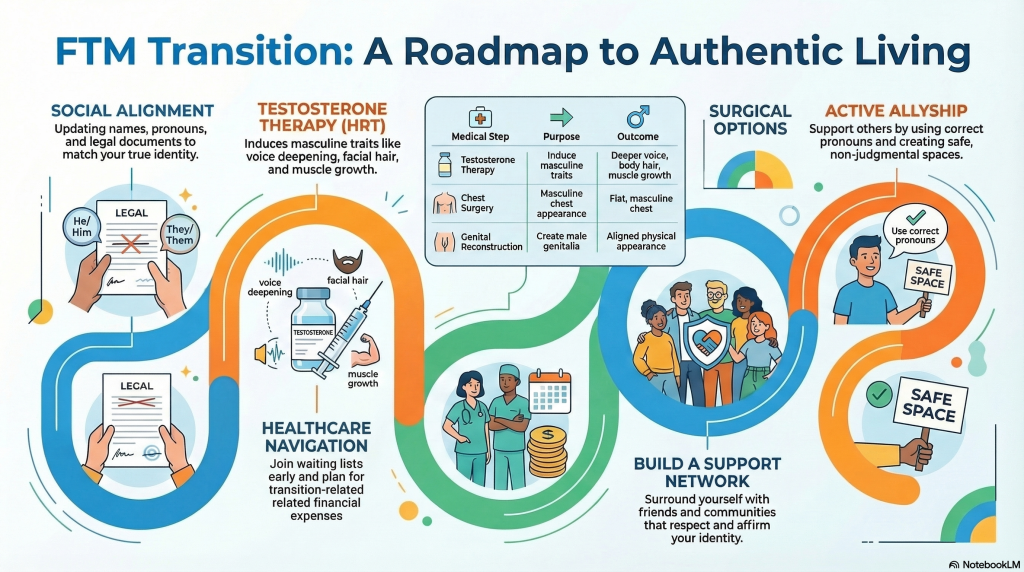
Testosterone therapy is a common initial step. It induces masculine traits like a deeper voice, increased body hair, and muscle growth. However, it’s crucial to have regular medical check-ups to monitor health and hormone levels.
| Medical Step | Purpose | Outcome |
|---|---|---|
| Testosterone Therapy | Induce masculine physical traits | Deeper voice, body hair, muscle growth |
| Chest Surgery | Create a masculine chest appearance | Flat, masculine chest |
| Hysterectomy | Remove internal female reproductive organs | Alleviate dysphoria, health benefits |
| Genital Reconstruction | Create male genitalia | Aligned physical appearance |
| Regular Monitoring | Ensure safety and effectiveness | Health and well-being |
Surgeries like chest masculinization (top surgery) and genital reconstruction (bottom surgery) can further help trans people feel more comfortable in their bodies, even though not everyone opts for every procedure. What you really need to know is that the medical transformation process is deeply personal, and each individual’s path is unique.
Social transformation for FTM individuals means changing their name, pronouns, and outward gender expression to match their true identity. This step is important for aligning their external life with their internal sense of self.
You’ll likely start by selecting a name that feels right for you, then updating your pronouns to he/him or they/them, depending on your preference.
Updating legal documents, like your driver’s license or passport, is another significant part of the social transition. This process can be time-consuming but is necessary for ensuring your identification matches your true gender. It’s a big step towards living authentically and can make daily interactions smoother.
Support from friends, family, and community is invaluable during this time. Surround yourself with people who respect your identity and use your chosen name and pronouns. This support network can help you through the inevitable challenges that come with social transformation.
Living as your true self and expressing your gender openly promotes mental well-being and self-acceptance. It’s about finding a sense of belonging within the transgender community and beyond.
Embracing these changes allows you to live authentically, fostering a happier and more fulfilling life.
After aligning your external life with your true identity, the next step often involves hormone therapy to develop masculine physical traits. Testosterone therapy, or T therapy, is a crucial process for many FTM individuals. It involves administering testosterone to induce changes that help align your body with your gender identity.
Here’s what you can expect with T therapy:
Hormone therapy is a critical step in your transformation, helping you feel more comfortable and authentic. Remember, each passage is unique, so consult with your healthcare provider to tailor the therapy to your needs.
Exploring surgical options is a significant step for many FTM individuals seeking to align their physical appearance with their gender identity. When considering surgery, it’s vital to understand the main procedures available: chest masculinization (top surgery) and genital reconstruction (bottom surgery).
Top surgery involves removing breast tissue and reshaping the chest to create a more masculine look. This procedure can greatly improve comfort and confidence.
Bottom surgery options include metoidioplasty and phalloplasty, both aimed at creating male genitalia. Metoidioplasty uses existing genital tissue to form a neophallus, while phalloplasty involves constructing a penis using grafts from other body parts.
Before deciding on surgery, think about factors like recovery time, potential risks, and your desired outcomes. Each procedure carries its own set of benefits and considerations. For example, top surgery usually has a shorter recovery period compared to bottom surgery, which is more complex.
It’s essential to thoroughly research and consult with experienced surgeons. Make sure you’re fully informed about what each procedure entails, the possible risks, and the expected results.
Your path is unique, and understanding your options will help you make the best decision for your transformation.
Understanding healthcare systems can be just as important as deciding on surgical options, as it guarantees you receive the proper medical support when you need it. Maneuvering these systems can be challenging, but with a proactive approach, you can streamline your path.
Here are some key steps to ponder:
Supporting FTM individuals starts with offering understanding and acceptance without judgment. It means recognizing their identity and respecting their chosen name and pronouns. Encourage open communication and create a safe space where they can express themselves freely. Show empathy by listening to their experiences and validating their feelings.
Offering emotional support is important. Acknowledge the challenges they face and be there to provide encouragement. Educate yourself about FTM experiences and challenges—this knowledge helps you become a better ally. Understanding their path includes learning about hormone therapy, surgeries, and the social adjustments they might undergo.
Providing resources and community support also plays a significant role. Connect them with affirming environments and communities that offer mutual support.
| Action | Why It Matters | How to Implement |
|---|---|---|
| Use correct pronouns | Shows respect and validation | Ask and consistently use their pronouns |
| Create safe spaces | Encourages open and honest expression | Listen actively without judgment |
| Educate yourself | Builds empathy and better support | Read up on FTM experiences and challenges |
| Offer resources | Connects them with necessary support and affirming networks | Share information about support groups |
Yes, a phalloplasty can improve an erection. After the surgery, an inflatable penile prosthesis is often inserted.
You activate it by squeezing a pump located in the scrotum, which allows the phallus to become firm for sexual activity. This improvement can greatly boost sexual function and satisfaction.
Make sure to discuss your options and preferences with your surgeon to choose the right prosthesis for you.
The difference between transman and transmasc lies in their gender identity spectrum. A transman identifies strictly as male and often undergoes changes like hormone therapy or surgery.
Transmasc, on the other hand, encompasses individuals who lean towards masculinity but may not identify strictly as male. They mightn’t pursue alterations and can express their gender in diverse, non-traditional ways.
Respect their chosen identities and expressions.
Imagine testosterone as the key to revealing your true self.
To get started, consult a transgender healthcare provider. You’ll need blood tests, physical exams, and mental health evaluations.
Testosterone can be delivered through injections, oral meds, or patches. Changes begin in weeks, gradually building over time.
Regular checkups confirm you’re on the right path. It’s a process, but it’s your individual experience, and it’s worth it.
You’ve learned the essentials of FTM identity, medical and social transitions, hormone therapy, and surgical options. But here’s the suspenseful part: the adventure doesn’t end here.
Exploring healthcare and gaining support are vital next steps. Are you ready to empower yourself or support a loved one even further? Embrace this path with confidence and curiosity—you’ll uncover a world of authenticity and acceptance waiting just beyond the horizon.
What comes next could change everything.
Originally posted 2024-06-24 03:41:21.

 News and AdvocacySeptember 5, 2026Administration Move Targets Trans Visibility
 Featured PostsAugust 27, 2026Transgender Identity: Ancient Roots and Modern Understanding
 Featured PostsAugust 27, 2026What Does Non-Binary Mean?
 Featured PostsAugust 27, 2026A Guide to Dating a Trans Woman