Mapping Refuge: The Most Welcoming and Supportive US States for Trans People in 2026

If you’re mapping safety in 2026, you can’t rely on slogans; you need laws, enforcement, healthcare access, ID policies, youth protections, and relocation support. States like California, Colorado, Minnesota, New York, Oregon, and Washington stand out, but local realities still matter. You deserve clear data before you travel, move, or help someone find refuge—and the strongest protections may not be where you expect.
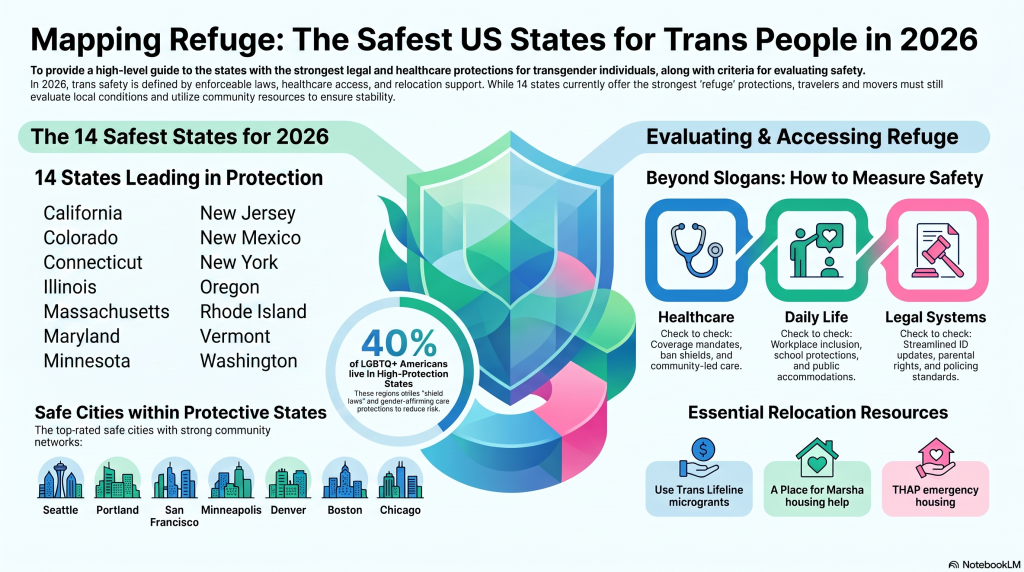
While no state can guarantee safety everywhere, the 2026 Anti Trans National Legal Risk Assessment Map identifies 14 states as the safest for trans and gender-diverse travelers: California, Colorado, Connecticut, Illinois, Massachusetts, Maryland, Minnesota, New Jersey, New Mexico, New York, Oregon, Rhode Island, Vermont, and Washington. You should treat this designation as a strong starting point, not a blank check. Use state tourism sites, LGBTQIA+ guides, and queer travel bloggers to verify current local conditions, bathroom access, and support networks. In protective states like California, Colorado, New York, Oregon, and Washington, policy strength often aligns with visible community outreach and local activism. Still, you’ll need caution: hostile pockets can exist anywhere, so research your route, identify affirming services, and plan safety contacts before you travel.
To judge whether a state is safe for trans people, look beyond reputation and measure the protections that shape daily life: nondiscrimination laws, accurate identity documents, access to gender-affirming health care, LGBTQ youth safeguards, parental recognition, criminal justice protections, and limits on religious exemptions that permit discrimination. You should also weigh enforcement, local culture, and whether policies survive real-world stress.
| Safety factor | What you should check |
|---|---|
| Health care | Coverage mandates, ban shields, Community led healthcare |
| Daily life | Workplace inclusion, schools, housing, public accommodations |
| Legal systems | ID updates, parental rights, prison and policing standards |
| Refuge support | Shield laws, microgrants, housing, LGBTQ centers |
Use equality maps, local ordinances, provider directories, and community reports together. Strong laws matter, but access determines whether you’re actually safe.

When you compare legal protections across the country, the strongest states cluster around enforceable nondiscrimination laws, accessible ID updates, protected gender-affirming care, LGBTQ youth safeguards, and limits on religious exemptions that enable discrimination. You’ll see this pattern in California, Colorado, Connecticut, Illinois, Massachusetts, Maryland, Minnesota, New Jersey, New Mexico, New York, Oregon, Rhode Island, Vermont, Washington, and D.C.
MAP’s Equality Maps rank 15 states plus D.C. with High Aggregate Policy Scores, while gender-identity protections score High in 16 states plus D.C. That matters because 22 states and three territories score Negative, leaving trans people exposed to denial of services, care, and recognition. In high-protection states, Community legal advocacy and Employment initiatives help turn statutes into enforceable rights, workplace access, and daily security.
As anti-trans laws push people to move, safe states help by pairing legal protections with practical relocation pathways. You’ll find the strongest refuge systems in California, Colorado, Connecticut, Illinois, Massachusetts, Maryland, Minnesota, New Jersey, New Mexico, New York, Oregon, Rhode Island, Vermont, and Washington, where nondiscrimination laws, shield policies, and gender-affirming care protections reduce risk.
You can use relocation supports that turn policy into survival: Trans Lifeline microgrants, A Place for Marsha housing and job connections, and THAP emergency housing. In states like Colorado and Maryland, expanded insurance rules help you keep care covered, while streamlined ID updates protect daily life. Community centers, legal aid groups, and LGBTQ+ resource hubs help you navigate housing, documents, and healthcare. Community sponsorship through groups like Rainbow Railroad can strengthen your move.
Before you travel or relocate, check state policy scores and local protections so you can match your route with real safety conditions. Use MAP Equality Maps: in 2026, 15 states plus D.C. score High overall, 16 plus D.C. score High for gender identity protections, and 40% of LGBTQ people live there.
Prioritize refuge states like California, Colorado, Illinois, Massachusetts, Maryland, Minnesota, New Jersey, New York, Oregon, Vermont, Washington, and Hawaii for stronger nondiscrimination, health-care, and ID rules. For travel safety, compare tourism sites, LGBTQIA+ guides, bathroom access, ordinances, and queer neighborhoods. Contact community resources such as local centers, Trans Lifeline, A Place for Marsha, or THAP for housing, jobs, aid, or microgrants. For asylum, consult Rainbow Railroad or Immigration Equality.
State protections act like a shield: you’re more likely to secure legal access, safer housing, IDs, school enrollment, and workplace rights. You also get stronger health navigation through Medicaid rules, nondiscrimination laws, and LGBTQ-competent services. For trans immigrants and asylum seekers, these policies reduce detention risks, improve case stability, and connect you to evidence-based care. You can advocate for data tracking, language access, and funding that turns protections into outcomes.
You’ll find strong trans communities in Seattle, Portland, San Francisco, Minneapolis, Denver, Boston, and Chicago, where nondiscrimination laws, affirming healthcare, legal aid, and mutual-aid networks overlap. A Portland neighborhood with LGBTQ centers can offer daily safety and referrals, while Austin collectives build rapid-response support despite state-level hostility. You should compare clinic capacity, shelter policies, hate-crime enforcement, school protections, and immigrant legal services to identify cities that turn protections into real stability.
Online rankings are lanterns, not maps: you can use them, but don’t trust them blindly. You should check data transparency, sources, update frequency, and whether lived-experience surveys balance legal and healthcare indicators. Metric biases can overrate states with good laws but weak access, or ignore rural risks. Compare multiple rankings, track anti-trans bills, consult local advocates, and treat rankings as starting points for policy action, not final verdicts.
No, protections don’t apply uniformly everywhere. You’ll see stronger coverage where laws define gender identity broadly, allow X markers, and ban discrimination in housing, jobs, schools, healthcare, and IDs. Nonbinary recognition often advances faster than Intersex protections, which may lack explicit safeguards against medical interventions, data erasure, or insurance exclusions. You should compare statutes, enforcement records, complaint data, and agency guidance, then push lawmakers to close gaps.
You can support trans refuge networks by funding verified mutual-aid groups, offering rides, housing leads, and childcare, and joining Volunteer coordination teams that track needs and outcomes. Push local officials to fund shelters, nondiscrimination enforcement, and clinic access. Host Legal workshops with trusted attorneys so newcomers understand IDs, benefits, and school rights. Share data securely, protect privacy, and follow trans-led priorities rather than setting agendas. Measure gaps, report harms, build capacity.
You deserve a state that protects your rights, funds your care, recognizes your ID, and defends your dignity. As 2026 maps show, refuge isn’t accidental; it’s built through statutes, budgets, clinics, schools, and community networks. So compare laws, call local centers, plan routes, secure records, and connect with legal aid before you move. Choose places that measure safety in policy, prove support in practice, and turn welcome into enforceable protection.

 Featured PostsJuly 11, 2026Mapping Refuge: The Most Welcoming and Supportive US States for Trans People in 2026
 News and AdvocacyJuly 6, 2026Federal Judge Shuts Down Trump Administration’s Push for Trans Kids’ Medical Files
 Featured PostsJuly 3, 2026Solitude, Not Silence: My Foundations for Living Alone
 Featured PostsJuly 3, 2026What Is Gender Affirming Care?