Defining Her: Embracing the Chaos, Power, and Grace of Being a Woman

What you may not know is that strength rarely begins with confidence; it often starts when you stop absorbing harm in silence. You define yourself each time you name what was done, refuse what diminishes you, and protect your labor, body, and peace. Chaos can sharpen your discernment, but it shouldn’t be mistaken for destiny. Power and grace don’t cancel each other; they make each other legible. What that looks like in practice is where this begins.
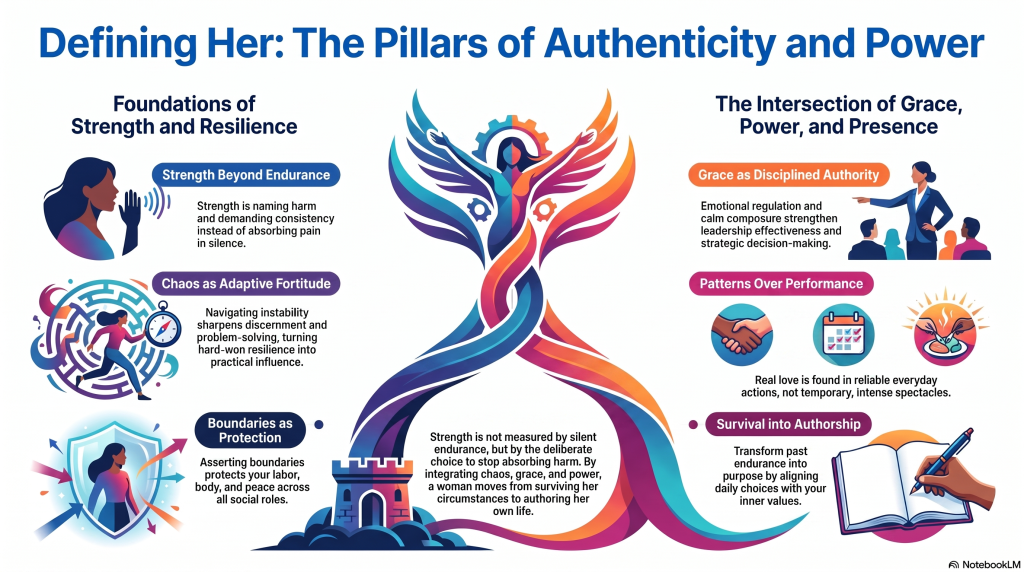
Strength isn’t measured by how much a woman can endure in silence, but by how deliberately she responds to what life asks of her. You embody strength when your emotional literacy lets you name harm, communicate needs, and demand consistency instead of accepting gestures without care or accountability.
You’re strong when boundary setting protects your labor, body, and peace across work, family, and community roles shaped by race, class, sexuality, and culture. Your moral compass keeps you aligned with values, not performance. You practice self compassion by choosing healing over bitterness, even when betrayal leaves scars. That choice doesn’t erase pain; it integrates wisdom without hardening your heart. A strong woman trusts intuition, seeks inner congruence, and builds a life that feels honest, engaged, and profoundly her own each age.

When chaos keeps interrupting a woman’s life—through family instability, betrayal, precarity, or the layered pressures of race, class, and gendered expectation—it doesn’t automatically make her stronger, but it often forces adaptation.
You learn adaptive fortitude through:
Research suggests moderate adversity can sharpen problem-solving and emotional regulation. When you carry wounds and wisdom together, you don’t become invulnerable; you become discerning. You read patterns, tolerate stress, and trust your intuition about life’s shape. That resilience shows up as emotional authenticity, clearer standards, and a greater capacity for relationships that are mutual, secure, and sustaining.

Because grace isn’t passivity but disciplined self-possession, it often moves in tandem with power. When you practice emotional regulation, you don’t shrink yourself; you strengthen your authority. Research links calm composure to leadership effectiveness, because people read steadiness as competence, especially when women are unfairly judged through racialized, classed, and gendered expectations.
You also build power through survival. When you’ve navigated instability or trauma, you often sharpen problem-solving and social intelligence, turning hard-won resilience into practical influence. Grace becomes visible in measured responses, accountability, and boundary-setting, which create trust networks around you. Those networks become social influence. Even culture reinforces this pairing, celebrating women who balance tenderness with strength. Under pressure, your regulated empathy supports strategic decisions, proving compassion and effectiveness can coexist without contradiction.
Often, consistent love means you don’t have to decode someone’s care from occasional intensity; you can trust it in the ordinary rhythm of their actions. As a strong woman, you read patterns, not performances. You need emotional reliability: honest communication, accountability, and repair that changes behavior.
This is everyday devotion, not spectacle. It’s shared responsibility, predictable boundaries, and steady presence that respects your full humanity across race, class, body, and history. If past hurt taught vigilance, consistent love answers with follow-through over weeks and years. It doesn’t gaslight your instincts; it helps your nervous system rest, because care becomes refuge, not uncertainty.
Build purpose and presence by turning survival into authorship: strong women take what once demanded endurance and shape it into values, direction, and visible self-trust. You don’t romanticize hardship; you extract lessons, and research shows adversity can sharpen goals and deepen meaning. Your inner compass strengthens when daily choices match your values, creating harmony, flow, and well-being.
Presence grows through emotional honesty, accountability, and boundaries. You say what you feel, own your impact, and watch whether others respond with consistent care. That protects emotional safety and makes reciprocal partnership more possible. You also practice deliberate visibility: composed, not performative; vulnerable, not self-erasing. In a world that misreads marginalized women, your grace under pressure becomes evidence of competence, leadership, and feminist self-definition on your own terms.
You perceive the feminine associated with chaos because patriarchal cultures often misread women’s cyclical, relational, and adaptive ways of moving through life as instability. They label emotional turbulence and complexity as disorder instead of intelligence. Across myth, psychology, and social roles, feminine energy also symbolizes creative disruption: the force that breaks patterns and generates new forms. When you perceive it intersectionally, “chaos” often names power that dominant systems can’t control.
A chaotic woman is someone you’d recognize like a glitch in a vinyl record: shaped by instability, yet refusing to let pain calcify her spirit. You notice rebellious intuition guiding her, while unapologetic vulnerability keeps her honest, discerning, and fierce. She doesn’t perform softness for patriarchy; she tests consistency, names harm, and demands care. If you meet her fully, you’ll find resilience, depth, accountability, and transformative love, too.
You define yourself each time you refuse silence, name harm, and choose boundaries that protect your body, labor, and peace. Chaos doesn’t erase you; it teaches you to bend without breaking. Your grace isn’t submission, and your power isn’t cruelty—they move together, like fire and light, warming what you love and exposing what would diminish you. When you practice steady love and honest presence, you don’t just survive womanhood—you author it, fully, on your own terms.

 Featured PostsOctober 17, 2026One Step Closer: Trans and Passing
 Activism and ChangeOctober 14, 2026I’m I7 and Male, I Don’t Know Whether or Not I am a Trans Girl
 Featured PostsOctober 13, 2026A New Beginning: Embracing the Realization That I’m Trans
 Featured PostsOctober 13, 2026Colorado and Michigan Join States Ending Medicaid Coverage for Trans Youth