Pride, Policy, and Punishment: LGBTQ+ Federal Employees Fight Back in Court

A transgender NSA analyst Sarah O’Neill alleges Trump’s 2025 order forced her to choose between misgendered restrooms and outing herself at work. Plaintiffs argue the policy conflicts with Title VII as interpreted in *Bostock* and invites discriminatory enforcement through agency rules. The lawsuits frame restroom access as a workplace-equality issue with concrete harms, from hostile conditions to job changes. Courts now have to decide whether executive power can narrow civil-rights protections—before more claims follow.
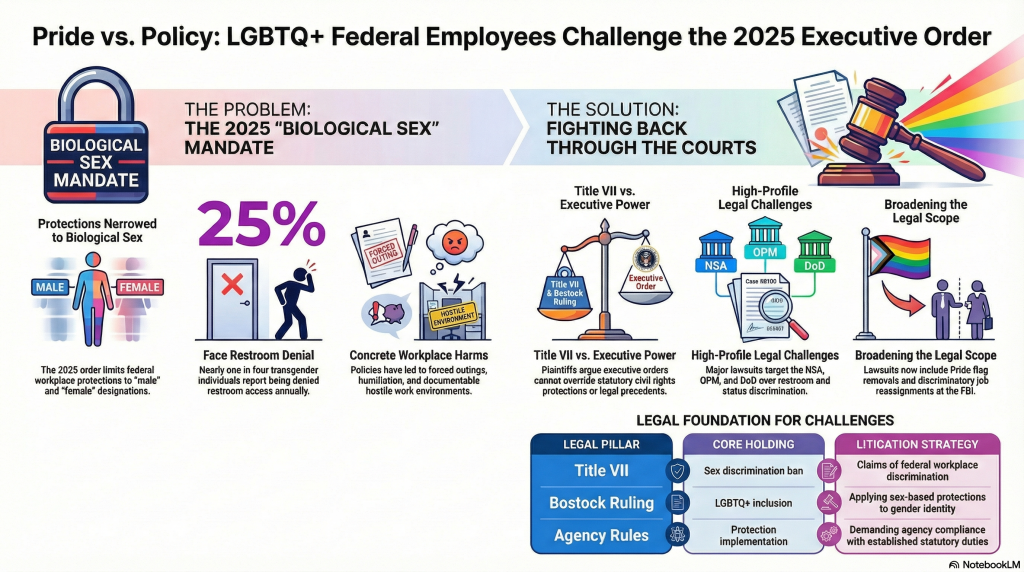
Although the administration framed it as a definitional clarification, Trump’s January 2025 executive order materially narrowed federal workplace protections by recognizing only “male” and “female” and directing agencies to enforce restroom access based on biological sex. Agencies translated that directive into daily gatekeeping, forcing transgender staff to choose between humiliation, discipline, or avoiding restrooms altogether. By denying gender identity as a cognizable status, the policy intensified workplace discrimination, emboldened supervisors, and signaled that complaints would face institutional resistance. Advocates reported a spike in inquiries and filings from LGBTQ+ federal workers as conditions deteriorated. Litigation followed quickly: LeAnne Withrow sued OPM in a putative class action over restroom access, and Sarah O’Neill alleged the NSA tolerated a hostile work environment. The Human Rights Campaign Foundation backed challenges emphasizing dignity and equal access.
Those day-to-day indignities now land in court against a legal framework that already treats LGBTQ+ bias as sex discrimination. Title VII bars federal discrimination, and the Bostock implications are plain: adverse action for transgender status or sexual orientation violates workplace rights. Plaintiffs argue Trump’s 2025 executive orders can’t narrow statutory coverage or erase legal precedents binding agencies. They frame the dispute as agency compliance: federal employers must follow Title VII and existing rules, not political directives that invite unequal treatment.
| Rule/Source | Core holding | Litigation hook |
|---|---|---|
| Title VII | Sex discrimination ban | Federal discrimination claim |
| Bostock | LGBTQ+ included | Bostock implications applied |
| Agency rules | Implement protections | Agency compliance duties |

After the January 2025 executive order required federal employees to use restrooms based on biological sex, restroom access became the clearest, most enforceable flashpoint for Title VII litigation because it translated abstract discrimination into a daily, documentable adverse condition of employment. Unlike broader claims about culture or speech, restroom policies impose repeated, compulsory encounters that agencies can’t plausibly treat as optional. Plaintiffs could plead concrete harms: forced outings, humiliation, and time lost searching for compliant facilities, all of which support hostile-environment and disparate-treatment theories. The restriction also signaled official endorsement of sex-based separation, making intent and causation easier to allege. By targeting basic bodily autonomy at work, the rule sharpened demands for injunctive relief and systemic compliance—linking transgender rights to workplace equality through a single, measurable policy lever.
Two lawsuits now anchor the legal pushback against the 2025 “biological sex” restroom mandate: Sarah O’Neill’s Title VII case against the NSA and LeAnne Withrow’s ACLU-backed class action targeting OPM and the DoD. O’Neill, a data scientist, alleges the agency barred her from women’s restrooms after the January 2025 order and thereby imposed workplace discrimination actionable under the Civil Rights Act of 1964. Her claim frames restroom exclusion as sex-based discrimination that alters job conditions and fuels a hostile work environment.
Withrow, an Illinois National Guard readiness specialist, challenges OPM and DoD policies that operationalize “biological sex” as a categorical denial of transgender status. Backed by legal advocacy, the suit argues Title VII can’t tolerate rules that erase identity and mandate unequal terms.
Beyond the NSA and OPM/DoD restroom fights, other LGBTQ+ federal workers have turned to court to challenge how the 2025 directives reshape speech rights, job duties, and access to healthcare. Maltinsky’s lawsuit says the FBI fired him for displaying a Pride flag that supervisors had previously approved, framing the termination as retaliation and viewpoint discrimination tied to Trump’s order dismantling diversity efforts. Mittereder’s challenges target DHS after TSA reassigned her away from pat-downs because she’s transgender, alleging sex-based discrimination and unequal terms of employment under Title VII. Parallel litigation pressures OPM: Withrow’s class action contests restroom restrictions as unlawful under the Civil Rights Act, while the Human Rights Campaign Foundation readies a class case arguing blocked gender-affirming care coerces workers to forgo medically necessary treatment.
Federal employees can report discrimination without risking retaliation by using confidential reporting channels, requesting workplace anonymity where available, and documenting every incident. They should file with an agency EEO office within deadlines, escalate to the EEOC or OSC for prohibited personnel practices, and preserve emails, witnesses, and timelines. They can seek counsel, request interim protective orders, and assert anti-retaliation rights, creating a litigation-ready record that deters reprisal.
Workers should document the denial, ask a supervisor for written clarification, and request an alternative accommodation while asserting restroom rights. Nearly 1 in 4 transgender people report being denied restroom access in a given year, underscoring urgency. They should file an internal EEO complaint promptly, preserve emails, witness names, and timelines, and contact counsel to assess injunctive relief. These immediate actions build a record for litigation and deter ongoing discrimination.
Contractors and interns aren’t always covered by the same LGBTQ+ workplace protections, but many can claim similar rights depending on their employment status and the laws invoked. Contractor rights often hinge on whether the worker qualifies as an employee under Title VII, plus contract clauses and federal nondiscrimination rules. Intern protections may arise under Title VII, state statutes, or agency policies. Litigation typically tests control, pay, and supervision.
Like a town crier with a laptop, coworkers and supervisors can support affected LGBTQ+ employees by affirming pronouns, ensuring confidentiality, and documenting incidents promptly. They can insist on inclusive policies, equal access to facilities, and nondiscriminatory assignments, and they shouldn’t retaliate against complaints. Supervisors can provide empathy training, clarify reporting channels, and preserve evidence for potential EEOC charges or litigation. Coworkers can serve as witnesses, accompany employees to HR, and counter harassment.
Employees can find confidential resources and legal aid through their union’s steward, local, or national counsel office, which can assign representation and advise on grievance timelines. They can also contact nonprofit civil-rights groups, state bar lawyer-referral services, and legal-aid clinics that screen for employment-discrimination claims. For federal workers, agency EEO offices and the MSPB’s resources outline appeal rights, while unions provide bargaining-unit advocacy and counsel.
Trump’s 2025 order recast federal workplaces as a battleground where dignity and equal protection collide. By tying restroom access and workplace expression to biological sex, agencies arguably sidestepped Title VII’s post-*Bostock* mandate and invited predictable harm: forced outing, retaliation, and chilled speech. In O’Neill’s and Withrow’s suits—alongside flag, duty, and care claims—plaintiffs aren’t seeking special treatment; they’re demanding the law’s plain promise, a shield not a sieve.

 Featured PostsSeptember 29, 2026A Kansas Law Voided 1,700 Licenses. Now Judges Must Decide Whether It Stands
 Featured PostsSeptember 29, 2026The First Time I Realised My Body Was Changing
 Featured PostsSeptember 28, 2026Staying Together After a Partner Comes Out as Trans
 Featured PostsSeptember 26, 2026Navigating Intimacy: A Trans Woman’s Path to Authentic Dating Experiences