What Exactly Is Conversion Therapy? Here’s Everything You Need to Know

Even if you’ve heard conversion therapy described as “just counseling” or a matter of faith, the evidence shows it’s a set of practices aimed at changing or suppressing your sexual orientation or gender identity. You should know these methods aren’t supported by credible medical science and can cause serious harm. To understand why experts reject them, it helps to look at what actually happens under this label.
At its core, conversion therapy refers to a range of practices that try to change, suppress, or “repair” a person’s sexual orientation, gender identity, or gender expression. You may also hear terms like SOCE or GICE. Clinically, these interventions are not supported by credible evidence, and major health organizations warn they can cause harm.
If you look at the history origins, you’ll see these efforts emerged from outdated beliefs that LGBTQ+ identities were disordered or morally wrong. Today, providers may include clergy, unlicensed counselors, family members, or some clinicians, often using softened labels to obscure intent. Survivor narratives consistently describe shame, coercion, and worsening mental health, including depression, substance use, and suicidal thoughts. For minors especially, experts often characterize exposure as abuse rather than legitimate care or treatment.

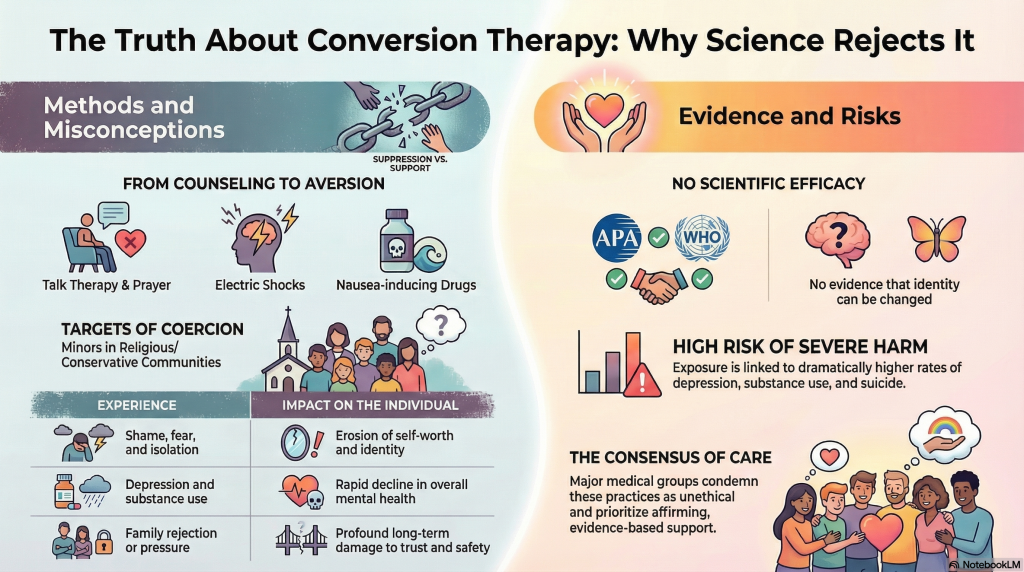
These practices take many forms, but they share the same goal: trying to suppress or change a person’s sexual orientation, gender identity, or gender expression. You may encounter talk therapy, cognitive restructuring, hypnosis, or behavior modification that rewards gender-conforming behavior and punishes nonconformity. Some providers use aversive conditioning, including electric shocks or nausea-inducing drugs.
You may also see religious techniques, such as pastoral counseling, prayer, exorcism, or scripture-based guidance, sometimes paired with deprivation or physical punishment. In documented cases, providers have used hormone manipulation, chemical or surgical castration, and, historically, brain surgery. Some programs have also misused gender-affirming procedures to try to “neutralize” orientation. These practices can come from unlicensed ministries, religious counselors, or licensed clinicians using euphemistic labels to avoid scrutiny or regulation.

Why doesn’t conversion therapy work? Because credible research hasn’t shown it can reliably change your sexual orientation or gender identity. Major reviews find little to no lasting change, and studies that claimed success were weakened by serious flaws, including retrospective self-report, self-selected samples, and missing control groups. There also aren’t randomized controlled trials supporting it.
When you look past efficacy myths, the pattern stays consistent. Large surveys show that reported “change” usually means suppressing behavior, adopting a role, or relabeling identity, not a durable shift in attraction. That’s why leading professional organizations, including the APA, AMA, AACAP, and WHO/PAHO, reject conversion therapy as evidence-based care. Survivor narratives align with this research: what gets described as success rarely reflects genuine, sustained change. Clinical guidance doesn’t recognize it as effective treatment today.
Because conversion therapy doesn’t work, its risks can’t be justified—and those risks are serious. If you’re exposed to it, research shows worse mental health outcomes, including depression, substance use, and suicidal thoughts or attempts. Family dynamics can deepen that harm, especially when rejection or pressure comes from caregivers.
| What you may experience | Why it matters |
|---|---|
| Shame, fear, isolation | These feelings can erode self-worth |
| Depression or substance use | Your mental health may decline quickly |
Survey data show rejected youth face dramatically higher risk of suicide attempts and severe depression. Major clinical organizations say these practices lack scientific credibility and can be harmful or abusive. For minors, the long-term psychological damage can be especially profound, affecting trust, identity, and safety. You deserve affirming, evidence-based care instead.
Although laws differ by location, conversion therapy isn’t medically accepted: major professional groups—including the American Psychiatric Association, American Psychological Association, American Medical Association, American Academy of Pediatrics, and PAHO—oppose it as unethical, unsupported by evidence, and potentially harmful.
Although laws vary, conversion therapy is not medically accepted and is widely condemned as unethical, unproven, and potentially harmful.
If you’re evaluating its legal status and medical consensus, focus on three facts:
You’ll find the legal status varies widely. About 26 U.S. states, Washington, D.C., Puerto Rico, and some countries restrict or ban it for health professionals. Some courts have also treated conversion practices as consumer fraud or abuse.
You’re most likely to face pressure into conversion therapy if you’re a young person, especially among young teens in religious families or conservative communities. You may also be vulnerable if you depend on caregivers, attend faith-based schools, or lack affirming support. Evidence shows LGBTQ+ youth experience this pressure disproportionately. Clinically, coercion often comes from authority figures who claim they’re helping, even when the practice increases depression, anxiety, and suicide risk.
Picture a funnel: affirming language narrows into pressure to “fix” you. You can recognize subtle forms when counseling, faith guidance, or family support treats your orientation or gender as a problem to change. Watch for microaggression signs, repeated shame, enforced gender roles, and identity erasure through “loving” advice. Evidence shows these tactics can harm mental health. Trust your discomfort, document patterns, and seek affirming, licensed support quickly.
If your child is targeted, act quickly: affirm them, make certain immediate safety, and document what happened. You should remove them from the harmful setting, contact a licensed mental health professional, and inform trusted school or community leaders. Seek legalities in your area so you understand reporting options and protections. Create support groups around your child, including affirming family, peers, and clinicians, to reduce isolation, stress, and long-term psychological harm.
You can find affirming mental health support like a lighthouse through fog: start with licensed therapists who explicitly offer trauma informed care and LGBTQIA+ competence. You should ask about their training, approach, and safety practices before booking. You can also seek peer support through survivor networks, community centers, or vetted online groups. If you’re in crisis, contact an LGBTQIA+ hotline or local emergency services immediately for confidential, urgent help.
Warning signs include a therapist who uses shame, dismisses your identity, misgenders you, or treats LGBTQ+ identities as symptoms, confusion, or pathology. You should also be cautious if a clinician endorses change in your orientation or gender identity, pressures you toward celibacy, or ignores minority stress. Affirming therapists support self-understanding, autonomy, and safety. If sessions leave you feeling judged, hidden, or less secure, trust that reaction.
If you’re asking what conversion therapy really is, the evidence is clear: it doesn’t change who you are, but it can deeply harm your mental health. The theory that sexual orientation or gender identity can be “fixed” has been repeatedly disproven by credible medical research. Instead, these practices are linked to trauma, depression, and suicide risk. You deserve care that affirms your identity, protects your safety, and reflects established clinical standards—not stigma disguised as treatment.

 Featured PostsSeptember 5, 2026Administration Move Targets Trans Visibility
 Featured PostsAugust 27, 2026Transgender Identity: Ancient Roots and Modern Understanding
 Featured PostsAugust 27, 2026What Does Non-Binary Mean?
 Featured PostsAugust 27, 2026A Guide to Dating a Trans Woman