The Silent Costs of Becoming Yourself

Becoming yourself can bring relief, but it can also unsettle the relationships and routines built around your old accommodations. When you name a need, decline a role, or set a limit, you may lose a sense of predictability before you gain a stronger sense of belonging. That loneliness doesn’t always mean you’ve made the wrong choice—it may reveal what your connections required from you. The harder question is what comes next.
The article examines the emotional and social challenges encountered by individuals who choose to live as their most authentic selves. It highlights how shifting personal identities often disrupt established relationships, leading to a temporary sense of isolation and mourning for abandoned futures. By addressing the necessity of boundaries, the text explains that guilt is frequently a byproduct of learned compliance rather than an indication of wrongdoing. The source also touches on the financial and professional risks associated with gender transition while emphasizing that these costs are often outweighed by the long-term benefit of genuine belonging. Ultimately, the author provides a roadmap for navigating self-discovery with patience, noting that true connections are built on acceptance rather than performance. Throughout the piece, mental health resources and community support are framed as essential tools for managing this complex life evolution.
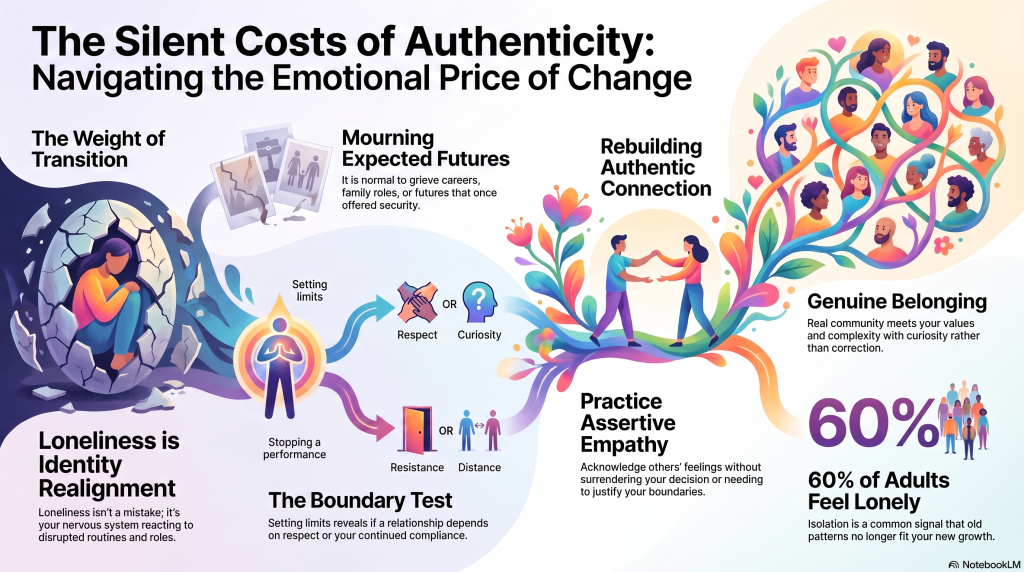
Authenticity can feel lonely because it often disrupts the unspoken agreements that once made belonging easier. When you stop minimizing your needs, masking preferences, or performing expected roles, your nervous system may register the change as risk. Social psychology shows that people rely on shared norms to predict acceptance; stepping outside them can create uncertainty before you find new stability. This doesn’t mean you’ve made a mistake. It reflects identity realignment: your choices, values, and self-understanding are becoming more congruent. Yet that process can produce emotional isolation, especially when familiar validation no longer fits. You may grieve the ease of being understood without explanation. Give yourself time to build internal trust, seek contexts that reward honesty, and recognize that temporary loneliness can accompany meaningful psychological growth.

As you become more honest about your needs, limits, and values, your relationships begin to reveal which forms of closeness can adapt to the real you. Inner honesty changes the agreements you once made silently: who initiates, who accommodates, and what you tolerate. Research on boundary-setting suggests clear communication can strengthen trust, though it may initially increase tension.
| When you change | A relationship may respond |
|---|---|
| You state a limit | With respect or resistance |
| You stop performing | With curiosity or distance |
This social recalibration isn’t proof that you’ve failed socially. It shows where connection depended on compliance, predictability, or shared avoidance. You can invite dialogue, listen without abandoning yourself, and notice consistent behavior over promises. Some bonds deepen because they gain accuracy; others become more limited, but honest.

Choosing a more authentic life can also mean mourning futures you once assumed were guaranteed: a certain career, family role, relationship, or version of belonging. When you change direction, you don’t simply gain freedom; you also confront lost plans that once organized your choices, identity, and sense of security.
Psychological research recognizes that people can grieve anticipated futures, not only concrete losses. You may feel sadness, anger, relief, or uncertainty, sometimes all at once. This quiet mourning doesn’t mean you made the wrong decision. It reflects your mind’s effort to revise a personal narrative shaped by years of expectation.
Give yourself room to acknowledge what mattered about the old vision. Naming its appeal can reduce shame and clarify what you still value. Over time, you can build meaning around what remains possible.
Boundaries often trigger guilt because they disrupt roles and expectations that once helped you feel accepted or safe. Yet guilt isn’t reliable evidence that you’ve done harm; it often reflects learned responsibility for others’ comfort. Clear limits protect your time, energy, and capacity for emotional labor while making relationships more honest.
Guilt after setting a boundary often reflects learned responsibility for others’ comfort, not evidence that you’ve done harm.
You don’t need a perfect explanation to justify a boundary. Practice tolerating discomfort; consistency teaches others what access you can genuinely offer.
Holding your limits can reveal which relationships value your compliance and which can make room for your full self. That information can sting, especially when belonging once depended on staying quiet, useful, or familiar. Yet research on authenticity and social support suggests that relationships built on mutual acceptance strengthen wellbeing more reliably than approval earned through self-suppression.
You can cultivate belonging by seeking people and spaces where your values, boundaries, and complexity receive curiosity rather than correction. Small identity rituals—sharing language, music, clothing, food, or stories that matter to you—can reinforce connection without requiring performance. Cultural pressures may still urge you to prioritize fitting in, family expectations, or social status. Notice when those pressures ask you to abandon yourself. Real belonging doesn’t demand that; it lets you participate, contribute, and change while remaining recognizable to yourself.
Living authentically can bring moving expenses, a wardrobe overhaul, therapy bills, career changes, or reduced family financial support. You might think authenticity must cost a fortune, but you can phase changes, use community resources, and budget intentionally. Research links identity affirmation to improved mental health and workplace engagement, which can protect long-term earning potential. Still, you’ll need savings for shifts, especially if housing, employment, or relationships shift unexpectedly.
Yes, authenticity can affect career opportunities and professional reputation. You may face career risks when your values, identity, or communication style conflict with workplace norms or leadership expectations. Bias can limit hiring, promotions, client trust, or networking access. Still, authenticity can strengthen credibility, engagement, and long-term fit. You can practice reputation management by setting boundaries, documenting achievements, reading organizational culture, and choosing how much personal information you share strategically at work.
Your identity-transition timeline varies widely: you may notice initial changes within months, while deeper stability often develops over one to several years. Research on behavior change and identity development supports gradual integration rather than a fixed endpoint. You’ll likely move faster when you have safety, supportive relationships, and practical resources. Expect setbacks and revisions; they don’t mean you’re failing. They show you’re testing what fits across different situations and roles.
Yes—therapy can steady you as self-discovery changes beneath your feet, like learning a new rhythm while crossing uneven ground. You can use emotional mapping to identify grief, fear, relief, and conflict without judging them. A therapist helps you test beliefs, build coping skills, and set relational boundaries when others resist your changes. Evidence supports therapy for improving emotional regulation, self-understanding, and relationship functioning during major identity shifts.
You may regret choices made while becoming more authentic, especially when they involve missed relationships or unfulfilled expectations. Regret doesn’t prove you chose wrongly; it often signals grief, uncertainty, or values that still need attention. You can review what you knew then, identify what you’d do differently now, and make repair where appropriate. Research on self-compassion suggests you’ll learn more effectively when you treat yourself fairly rather than punish yourself for evolving.
Choosing yourself can feel lonely before it feels liberating. Research suggests that 60% of adults report feeling lonely at times, reminding you that isolation isn’t proof you’ve made the wrong choice—it’s often a signal that your old patterns no longer fit. As you set limits, grieve lost expectations, and seek reciprocal relationships, you create room for belonging that doesn’t require performance. The discomfort is real, but so is the possibility of being fully known.

 Featured PostsOctober 21, 2026The Trans Journey to Passing
 Featured PostsOctober 17, 2026From Job Search to Success: A Transgender Woman’s Employment Journey
 UncategorizedOctober 17, 2026Trans Rights at Risk? The Implications of a Trump 2024 Win
 Featured PostsOctober 17, 2026One Step Closer: Trans and Passing