Finding Joy in Your Gender Expression

A small change in how you dress, move, or introduce yourself can reveal what feels right. You don’t need to settle on a label or meet anyone else’s expectations to investigate your gender expression. Start with choices that spark comfort or curiosity, and give yourself room to change your mind. Even uncertainty can offer useful clues—and one gentle experiment may show you where to go next.
The provided source offers a guide on personalizing gender expression through low-pressure experimentation with aesthetics and social identifiers. It emphasizes that individuals should prioritize internal comfort and joy over societal expectations or the need for immediate, permanent labels. By making small adjustments to clothing, hairstyles, and pronouns, people can safely discover what feels most authentic to their unique identity. The text also reframes feelings of doubt as natural components of self-discovery rather than setbacks. Ultimately, the article encourages seeking out supportive communities to foster a sense of belonging and safety during this ongoing process of self-realization.
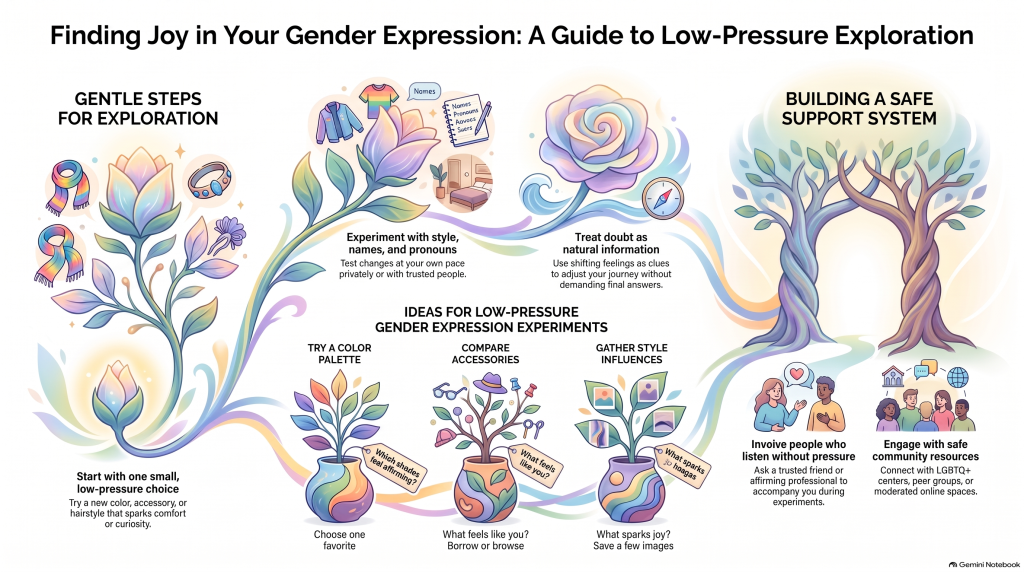
Start with one small choice that feels right to you, such as trying a new color, hairstyle, or accessory. Let your gender identity guide your starting point, not pressure to meet anyone else’s expectations. Your personal experience may begin with a quiet feeling, a question, or a clear sense of what brings you comfort. Notice what creates an emotional connection and supports self-acceptance. You don’t need to follow societal norms or explain your choices to others. Creative expression can reflect your tastes, values, and cultural influences in ways that feel meaningful to you. If you’d like support, community engagement can help you find understanding and encouragement. Choose a direction that feels manageable, then give yourself room to learn. There’s no single right way to express who you are.

Try small gender expression experiments in ways that feel safe and low-pressure. You can investigate what feels joyful without making a lasting commitment. Let curiosity guide you, and adjust each idea to your comfort levels.
| Experiment | Notice | Keep it gentle |
|---|---|---|
| Try a color palette | Which shades feel affirming? | Choose one favorite |
| Compare accessory choices | What feels like you? | Borrow or browse |
| Gather style influences | What sparks joy? | Save a few images |
You might also reflect on gender symbols or cultural references that matter to you. Consider their meaning and context, especially when they come from communities beyond your own. There’s no right result: you can enjoy an experiment, change your mind, or decide it isn’t for you. Your expression belongs to you, and small revelations can help you find what feels authentic.

Clothes, hair, names, and pronouns can all be ways to express your gender, and you can examine them at your own pace. Notice what feels comfortable, exciting, or simply interesting. Your fashion identity might include familiar pieces, new colors, or styles that challenge expectations. You can try hairstyle experimentation with a different cut, accessories, or a temporary change before making a bigger decision. If you’re inquisitive about a name, investigate its sound, meaning, and name significance to you. You might use it privately, with trusted people, or in a setting where you feel safe. Share your pronoun preferences with others when you’re ready, and let them know how they can support you. There’s no required look or label; you get to choose what feels like you.
Investigating clothes, hair, names, and pronouns can bring up doubt, and that doesn’t mean you’re doing anything wrong. You may be curious whether a choice feels right, worry about changing your mind, or compare your experience with someone else’s. You don’t need certainty or a label to investigate. Try noticing how each choice feels in different moments, without demanding a final answer.
Your preferences may shift, stay steady, or surprise you. Any of these paths can belong to your self-acceptance quest. When doubt appears, treat it as information, not proof that your feelings aren’t real. You can pause, revisit an experiment, or keep what brings you ease. Embracing authenticity doesn’t require you to explain yourself or meet anyone else’s expectations. You get to move at your own pace.
As you investigate your gender expression, supportive people can make the process feel safer and more joyful. You deserve respect whether you’re examining quietly, making changes, or feeling certain about what fits. Look for people who listen without pressuring you to explain or choose a label.
Support can come from one person or a whole community. You can set boundaries, change your mind, and choose what feels right at your own pace.
Yes—your gender expression can shift like a wardrobe changing with the seasons. You might investigate new styles, gestures, or ways of presenting yourself as your needs and feelings evolve. Gender fluidity, cultural influences, and societal expectations can all shape your personal path, but they don’t define it. Notice your emotional connection to each choice, and let creative expression guide you. You deserve room to change, stay the same, or simply find what feels right.
No, gender expression isn’t the same as gender identity. Your identity is your inner sense of who you are; your expression is how you present yourself through clothing, behavior, or appearance. They may align, but they don’t have to. Gender fluidity, cultural influences, and societal norms can shape how you navigate the expression spectrum. You deserve personal authenticity without pressure to fit expectations. Self realization is yours to define, at your own pace.
No—you don’t need a label for your gender expression. You can choose one if it helps you describe yourself, but you can also leave your experience unnamed. Your self exploration may involve gender fluidity, cultural influences, or shifting feelings over time. A label can support personal authenticity, but it shouldn’t become another set of societal expectations. Notice what brings you emotional resonance, and keep in mind that your words—or lack of them—are yours to choose.
Yes, your gender expression can affect how others perceive you, though their responses reflect their assumptions—not your worth or identity. Social perceptions and cultural influences shape what people expect from clothing, hairstyles, or mannerisms. Your personal experiences may differ across settings, including workplace dynamics and family reactions. Media representation can also influence understanding. You deserve respect wherever you express yourself, and you can choose what feels comfortable and safe for you.
There’s no single right or wrong way for you to express your gender. Your choices may reflect cultural influences, personal experiences, emotional connections, or simply what feels comfortable today. You don’t have to meet societal expectations or prove your identity to anyone. Your expression can change over time, and it may look different from someone else’s. Trust what feels authentic to you, and keep in mind that you deserve respect, support, and room to investigate.
Your gender expression doesn’t need to follow anyone else’s map. Keep choosing the colors, clothes, names, or pronouns that feel right, and give yourself room to change your mind. If doubt appears, remember: Rome wasn’t built in a day. Each small experiment can help you notice what brings you comfort and joy. Lean on people who respect your path, and celebrate every step toward feeling more at home in yourself. You deserve that joy, exactly as you are.

 Featured PostsOctober 17, 2026One Step Closer: Trans and Passing
 Activism and ChangeOctober 14, 2026I’m I7 and Male, I Don’t Know Whether or Not I am a Trans Girl
 Featured PostsOctober 13, 2026A New Beginning: Embracing the Realization That I’m Trans
 Featured PostsOctober 13, 2026Colorado and Michigan Join States Ending Medicaid Coverage for Trans Youth