NO ON PROP 134&135 (Colorado)

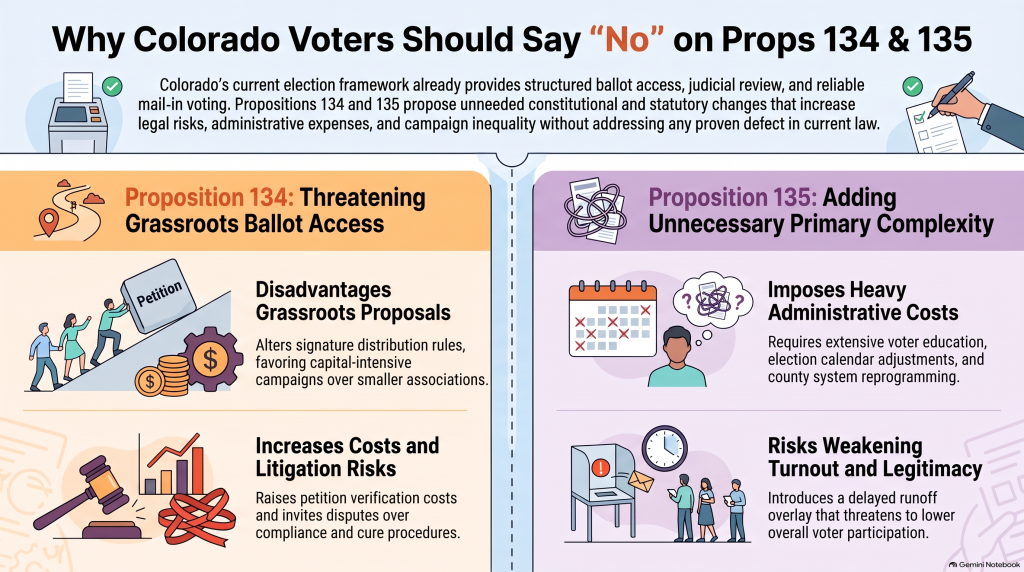
Two ballot measures, Props 134 and 135, should be rejected because they’d alter election and constitutional procedures without a demonstrated public need, while creating foreseeable legal and administrative risk. In Colorado, election law already provides structured access to the ballot, judicial review, and defined petition standards.
The provided source argues that Colorado voters should reject Props 134 and 135 because they unnecessarily disrupt established election procedures without a proven public benefit. Specifically, the text explains that Prop 134 would alter signature distribution rules, which would disproportionately harm smaller grassroots proposals while favoring well-financed campaigns. Additionally, the author warns that Prop 135 would introduce an untested top-four primary system that could lead to administrative headaches, increased expenses, and diminished voter participation. Ultimately, the commentary urges citizens to vote against both initiatives to preserve a dependable and economically sound electoral framework.
These initiatives would revise those settled mechanisms in ways that invite litigation, complicate compliance, and produce uncertain implementation timelines. Their proponents haven’t shown a concrete defect in current law that justifies constitutional or statutory disruption. Sound public policy requires necessity, administrability, and clear benefit; these measures don’t satisfy that standard under accepted governance principles.
Prop 134 would change signature distribution requirements for statewide initiatives. Although framed as broadening geographic participation, it would burden petition circulation, raise verification costs, and advantage campaigns with substantial funding and statewide field operations.
Prop 134 would burden petition access, increase verification costs, and favor well-funded statewide campaigns over grassroots initiatives.
That design creates measurable voter impact by limiting which grassroots proposals can realistically qualify. It also carries economic consequences for civic groups, election administrators, and courts that would have to resolve disputes over compliance, cure procedures, and possible invalidation. A ballot-access system shouldn’t privilege capital-intensive campaigns over smaller associations absent compelling evidence that current rules are inadequate or unfair.
Prop 135 would impose a top-four primary structure followed by a delayed runoff. That redesign would require extensive statutory revision, new election-calendar coordination, voter education expenditures, and administrative reprogramming across counties.
It could also reduce turnout in a separate runoff, thereby weakening representational legitimacy rather than strengthening it. Because Colorado already conducts robust mail-ballot elections with established timelines, the proposed overlay would add complexity without proving a corresponding public benefit.
Voters should reject both measures and preserve a coherent election framework that remains predictable, legally durable, and cost-conscious. Rejection would protect orderly administration and maintain accountability within existing constitutional processes statewide.

 Activism and ChangeOctober 7, 2026NO ON PROP 134&135 (Colorado)
 Featured PostsSeptember 29, 2026A Kansas Law Voided 1,700 Licenses. Now Judges Must Decide Whether It Stands
 Featured PostsSeptember 29, 2026Privacy, Dignity, and Rights: The Transgender Bathroom Controversy
 Featured PostsSeptember 29, 2026Finding Your Feminine Voice: A Guide to MtF Voice Therapy