Strategic Shifts: Analyzing the Latest GOP Policy Proposals Regarding LGBTQ+ Households

Over 60% of Americans now support same-sex marriage, yet a GOP think tank’s latest proposal directly challenges this progress. You’re witnessing a strategic push to redefine family norms, sidelining LGBTQ+ rights in the process. These proposed policies could strip away crucial protections for gay families, impacting everything from tax benefits to adoption rights. As you consider the broader implications, you may be curious: what’s really driving this renewed assault on equality?
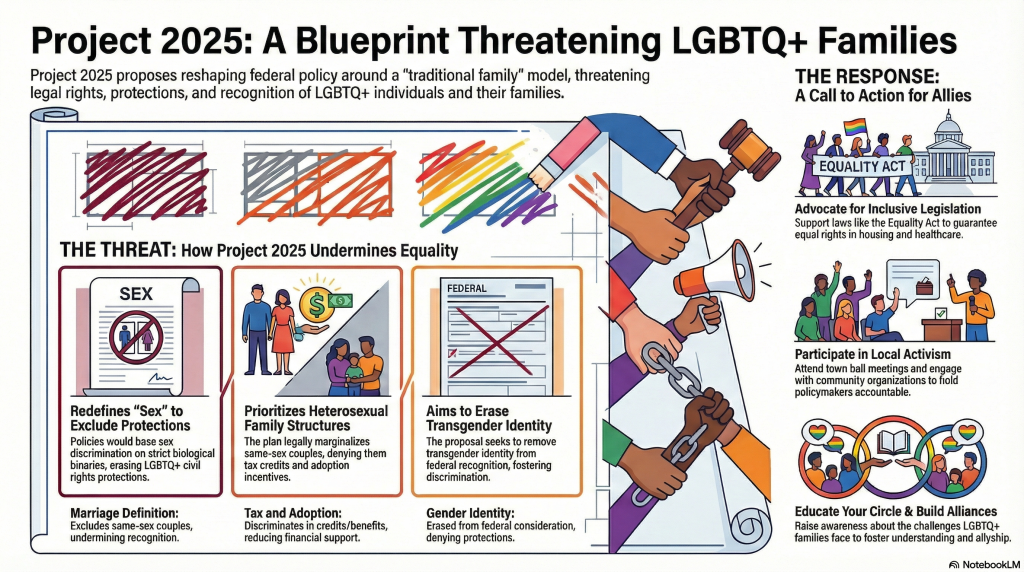

While Project 2025 positions itself as a reformative initiative, its underlying objectives pose significant threats to LGBTQ+ protections. The proposal to redefine sex discrimination to only consider biological binaries has serious legal implications. By erasing inclusive language from federal agencies, you risk undermining years of progress in LGBTQ+ rights. Such shifts could prompt a strong social backlash, as communities mobilize against perceived regressions in civil rights. Furthermore, prosecuting pro-trans educators as sex offenders could create a chilling effect in educational settings, discouraging support for LGBTQ+ students. These legal implications not only threaten individual freedoms but also foster a divisive atmosphere. You’re likely to witness increased polarization, as policies that marginalize LGBTQ+ individuals spark nationwide debates and resistance.

The threats posed by Project 2025 extend beyond individual rights to encompass the broader framework of LGBTQ+ family rights. By prioritizing heterosexual family structures, these policies aim to enforce legal exclusion of LGBTQ+ families from vital benefits and protections. You’re confronted with a redefinition of family structures, specifically designed to marginalize same-sex couples, denying them tax credits and child adoption incentives. Such exclusion not only undermines family stability but also reshapes societal norms to disadvantage LGBTQ+ individuals. The proposal’s attempt to eradicate transgender identity from federal recognition further disrupts family dynamics, leaving LGBTQ+ families vulnerable. By eliminating anti-discrimination regulations, the initiative fosters an environment of increased prejudice, fundamentally altering legal and social contexts for LGBTQ+ families.

As Project 2025’s policies unfold, LGBTQ+ rights and protections face significant threats, reshaping the landscape of equality. The initiative’s actions undermine LGBTQ+ advocacy by proposing a restrictive definition of marriage and sex discrimination. Family equality hangs in the balance as these changes could marginalize non-heterosexual families, limiting access to essential benefits. You might find this table helpful:
| Policy Area | Impact on LGBTQ+ Rights | Implications for Family Equality |
|---|---|---|
| Marriage Definition | Excludes same-sex couples | Undermines recognition of diverse families |
| Tax and Adoption | Discriminates in credits and benefits | Reduces financial support for LGBTQ+ families |
| Gender Identity | Erased from federal considerations | Denies protections for transgender individuals |
These policies threaten systemic discrimination, reinforcing barriers to equal rights.
Amidst a shifting political landscape, the GOP’s push against LGBTQ+ rights is driven by a strategic realignment towards traditional family structures. This movement, as outlined in Project 2025 by the Heritage Foundation, frames the prioritization of heterosexual families as a response to what they perceive as a cultural backlash against evolving family norms. The push stems partly from a political strategy to capitalize on concerns about family stability, allegedly disrupted by marriage equality and gender identity recognition. By advocating policies that marginalize LGBTQ+ families, such as redefining marriage and targeting gender identity, the GOP aims to appeal to conservative voters who feel alienated by these societal changes. This approach seeks to swiftly enact legislation, often bypassing public discourse, to reinforce their agenda.
Addressing the GOP’s strategic moves against LGBTQ+ rights requires a proactive response to support affected families. You can be instrumental in countering discrimination by utilizing community resources and promoting ally education. Here’s how:
Take a stand against discrimination by engaging community resources and fostering education to support LGBTQ+ families.
Each step strengthens the fabric of support for LGBTQ+ families.
You want to know who funds the Heritage Foundation‘s Project 2025. The Foundation receives support from diverse funding sources, including individual donors, corporations, and foundations. While they claim to adhere to donor transparency, specific contributors to this particular project are often not disclosed publicly. By analyzing their financial reports, you might gain insights into some of their backers, though fully understanding their donor network remains challenging due to privacy considerations.
Religious groups are showing mixed reactions to Project 2025. Some express religious backlash, fearing it could marginalize their inclusive beliefs. Others offer community support, aligning with the project’s values. Your analysis should consider how these reactions might influence broader societal dynamics. Look for how religious communities balance between upholding traditional values and fostering inclusivity. This project might reveal deeper divisions or unity within the religious landscape.
You might see Project 2025 facing significant legal challenges based on established legal precedents and constitutional challenges. Courts could scrutinize whether the plan infringes upon equal protection rights under the Fourteenth Amendment. Legal precedents set by previous Supreme Court rulings, such as Obergefell v. Hodges, might serve as formidable barriers. Attorneys would likely argue that the plan discriminates against specific groups, potentially leading to legal battles in federal courts.
In the 1980s, 57% of Americans opposed same-sex marriage, reflecting historical anti-LGBTQ+ legislation trends. You’ve seen precedents like the Defense of Marriage Act in 1996, which barred federal recognition of same-sex marriages. Societal backlash examples include the LGBTQ+ rights marches that countered such policies. Analyzing this, it’s clear that initiatives often meet resistance, fueled by evolving public attitudes and legal challenges, gradually shifting towards equality and acceptance.
International LGBTQ+ organizations are rallying together, showing global solidarity and strengthening international advocacy efforts. One observes them rapidly coordinating responses, sharing resources, and amplifying each other’s voices across borders. They’re focused on raising awareness and leveraging diplomatic channels to counteract these developments. By uniting, they aim to reinforce protective measures and influence policymakers worldwide. Their strategic collaboration highlights a commitment to defending human rights and ensuring the safety and dignity of LGBTQ+ individuals.
You stand at a crossroads where the shadows of discrimination threaten to obscure the hard-won rights of LGBTQ+ families. Project 2025 is a storm on the horizon, jeopardizing equality by pushing an agenda that prioritizes traditional family structures. To shield against this, advocates must rally and fortify legal protections. Like a lighthouse guiding through turbulent seas, your support can illuminate a path toward inclusion and justice, ensuring that love and rights remain indivisible for all families.

 Featured PostsJanuary 30, 2026Threat Assessment: 47 Organizations Launch National Initiative Against LGBTQ+ Marital Equality
 Featured PostsJanuary 30, 2026My Wife Doesn’t Know I’m Trans
 News and AdvocacyJanuary 30, 2026Opinion/Analytical: The Minneapolis Arrest of Don Lemon: A Dangerous Precedent for Modern Journalism
 Activism and ChangeJanuary 29, 2026Strategic Shifts: Analyzing the Latest GOP Policy Proposals Regarding LGBTQ+ Households