The Truth About Trans-Inclusive Restrooms: Evidence vs. Outrage
You’ve probably noticed a coincidence: the louder the headlines about trans women in bathrooms get, the thinner the incident data often looks. When you check law-enforcement logs, campus reports, and systematic reviews, you don’t witness a measurable spike in assaults after trans-inclusive policies. Instead, you see a mismatch between viral clips and baseline reality, plus actual costs of policing and bans. The question is what that gap is actually doing—and who it’s targeting…
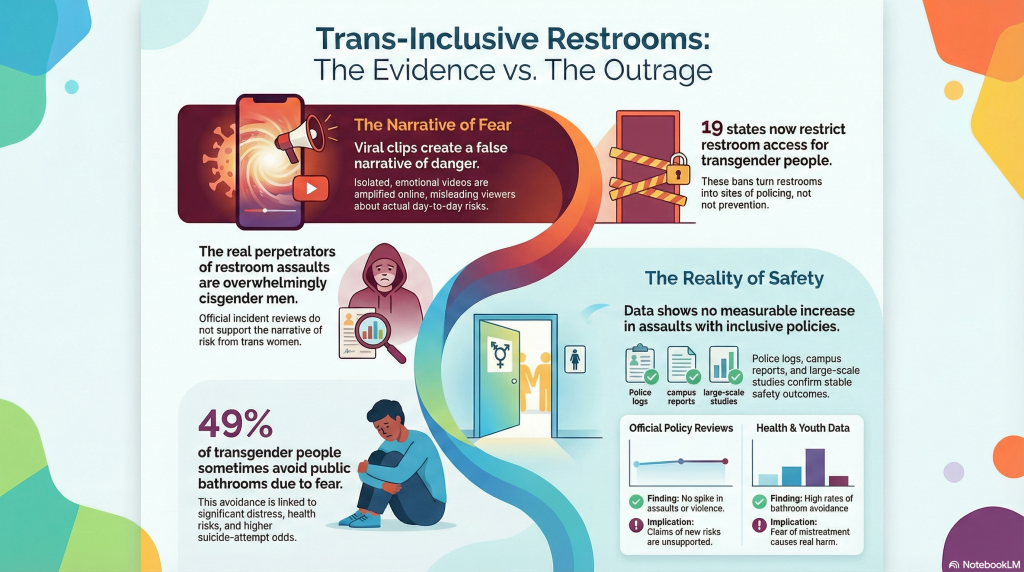
Often, the data doesn’t support the idea that women’s bathrooms are sites of frequent conflict tied to trans-inclusive access. When you look for frequency estimates in law-enforcement logs, university reports, and municipal complaint systems after inclusive policies take effect, you typically find baseline-level reporting and little to no measurable uptick tied to trans access. Real-world incident reviews also show reported harms overwhelmingly involve cisgender men, not transgender women, so you can’t credibly treat trans inclusion as a new risk generator. You should also track harassment drivers: surveys show many transgender people avoid restrooms because they expect mistreatment, meaning conflict more often targets trans users than cis women. Viral confrontations may look common, but follow-ups usually reveal isolated events, not systemic patterns.

When you check what’s happened in places that adopted trans-inclusive restroom policies, the safety picture stays flat: multiple studies, national surveys, and large-scale policy reviews find no increase in public-restroom assaults or sexual violence after access aligns with gender identity. You also see who bears the risk: trans people report fear, avoidance, and documented harms when excluded, while perpetrators of restroom assaults are overwhelmingly cisgender men, not trans women.
| Evidence | What you observe | What it implies |
|---|---|---|
| Policy reviews | No assault spike | Stable safety outcomes |
| Surveys | No violence linkage | Risk claims unsupported |
| Williams/health data | 49% sometimes avoid | Fear shapes behavior |
| Youth data | 22% always avoid | Isolation, distress rise |
Scroll through a short, emotionally charged bathroom or locker-room clip and you’ll see how outrage catches fire faster than verification: partisan accounts push it into high-engagement feeds, algorithms reward the conflict, and the video’s missing basics—date, location, and investigative follow-up—rarely slow it down. In the attention economy, a confrontation at Gold’s Gym Beverly Hills or a Planet Fitness stall video can be repackaged as “breaking” for months, while platforms and reporters later note it’s resurfaced without full verification. You’re also primed by captions that supply a narrative the footage can’t prove. With selective editing, an onlooker’s discomfort becomes “evidence” of a trans threat, and celebrity names add lift. Meanwhile, corrections and low-incidence assault data spread slower and reach fewer viewers overall.
Because bathroom bans turn a routine necessity into a compliance check, they shift policy from “who feels safe” to “who gets questioned”—and 19 states now restrict transgender people’s restroom use with enforcement that ranges from signage and staff challenges to misdemeanor penalties in limited settings (such as certain Florida government buildings if someone refuses to leave). You don’t get safer restrooms; you get institutional policing despite data showing no rise in assaults from trans-inclusive access, while most assaults involve cisgender men. Policing drives you toward distant single-occupancy options, increasing avoidance: 49% of trans youth sometimes avoid public bathrooms, and avoidance correlates with nearly double suicide-attempt odds. The result is Public shaming and Health impacts, not prevention.
Bathroom bans turn necessity into policing—staff challenges, forced outings, and harmful avoidance—without making restrooms safer.
Act fast and stick to verifiable facts: if you feel unsafe in a restroom or locker room, alert staff or management immediately, ask to be escorted to a secure area, and report the specific conduct you observed (harassment, exposure, threats) rather than speculating about someone’s identity. If the situation escalates, notify staff again and, for crimes like indecent exposure, threats, or assault, call police and request an incident report. For non-emergency misconduct, document discreetly if it’s safe: note date, time, location, and descriptions, and preserve evidence such as photos, video, or relevant posts. When you report to a gym, school, or airport, request written confirmation, ask which policy applies, and what remedial steps they’ll take. If you worry about bias claims, stick to behavior.
Trans people typically use the restroom that matches their gender identity, so you’ll see trans women in women’s toilets and trans men in men’s. You can also choose single‑occupancy or all‑gender options when available, depending on bathroom access and public signage. Surveys show many trans people avoid bathrooms when denied access, raising health risks. Evidence shows assault risk comes overwhelmingly from cisgender men, not trans users.
Sometimes—you can’t always choose, and the law can feel like a locked door. In some jurisdictions, you must use women’s toilets if your sex assigned at birth controls access, despite your legal recognition elsewhere. Policies often cite privacy concerns, yet studies link forced mismatches to higher anxiety, avoidance, and increased suicide-attempt risk. If you face restrictions, you’re often routed to single-occupancy restrooms, adding stigma and distance.
You typically use the bathroom that matches your gender identity, following bathroom etiquette and any posted rules. In many U.S. cities and institutions, policies and legal protections support that practice, and studies don’t show increased assault risk from inclusive access. If a gender-neutral or single-stall option exists, you can choose it for privacy. Where restrictive laws apply, you may have to use sex-assigned facilities or designated alternatives.
You perceive the controversy because gender-neutral bathrooms challenge bathroom policy and social norms: who gets access, how privacy’s protected, and who feels safe. Like a town gate re-hung for everyone, some welcome easier passage, others fear misuse. Evidence doesn’t show increased assaults, but opponents cite privacy risks. Studies report higher comfort with lockable single stalls and clear signage. Laws in 19 states restrict use, fueling disputes.
When you look past headlines, you don’t find a wave of women’s bathroom conflicts—you find a mirage. Systematic reviews, police logs, and campus reports show no measurable rise in assaults after trans-inclusive policies. What does increase is fear, fueled by viral clips stripped of context and by enforcement that targets gender-nonconforming people. If you want safety, back clear conduct rules, good lighting, and reporting systems—measures that reduce harm for everyone.

 Featured PostsOctober 21, 2026The Trans Journey to Passing
 Featured PostsOctober 17, 2026From Job Search to Success: A Transgender Woman’s Employment Journey
 UncategorizedOctober 17, 2026Trans Rights at Risk? The Implications of a Trump 2024 Win
 Featured PostsOctober 17, 2026One Step Closer: Trans and Passing