Are You Wired With a Girl Brain: Exploring Gendered Neuroscience

When you think about the classic nature versus nurture debate, you might wonder if your brain is wired more like a girl’s or a boy’s. Studies suggest women excel in verbal skills and emotional processing, possibly due to certain brain structures like the hippocampus. But here’s the twist—neuroplasticity shows that your experiences and learning shape your brain more than you might think. So, how much of this is biology, and how much is shaped by society? Stick around to uncover the myths and truths behind gendered neuroscience.
In relation to brain structure, men and women show some distinct differences that can impact everything from emotions to memory.
For instance, men’s brains are generally larger in total size compared to women’s. However, women have a larger hippocampus, the part of the brain essential for learning and memory. This structural difference can influence how each gender processes information and recalls memories.
When it comes to emotional processing, male and female brains also differ. Men typically have a larger amygdala, which is the brain region linked to emotions like fear and pleasure. This size difference means men’s emotional responses might operate differently compared to women’s.
On the other hand, women’s brains show more inter-hemispheric communication, meaning the left and right sides of their brains work together more seamlessly. This connectivity can affect cognitive abilities, potentially giving women an edge in social behavior and multitasking.
These structural differences are fascinating because they highlight how genetic variations, such as those related to XX and XY chromosomes, contribute to the physiological and cognitive distinctions between the sexes.
Understanding these differences helps us appreciate the unique strengths of male and female brains without reinforcing stereotypes.
While structural differences in male and female brains are evident, these variations also lead to distinct behavioral patterns that shape how each gender interacts with the world. For instance, you might notice that females generally excel in verbal abilities and fine-motor coordination, while males often have superior visuospatial skills and working memory capabilities. These sex differences in the brain can influence daily activities and even career choices.
Interestingly, research on infants shows early onset of these behavioral tendencies. Female infants tend to prefer social interaction and verbal communication, whereas male infants are more inclined towards spatial-visualization tasks. Even in rhesus monkeys, males show a preference for mechanical toys, while females favor dolls, suggesting that these behavioral tendencies might have a biological basis.
| Behavior | Females | Males |
|---|---|---|
| Verbal Abilities | Higher | Lower |
| Visuospatial Skills | Lower | Higher |
| Social Interaction Preference | Higher | Lower |
Moreover, neuropsychiatric disorders exhibit noticeable sex differences. Women are twice as likely to experience clinical depression and PTSD, while men show higher rates of alcoholism and schizophrenia. Boys are also diagnosed with dyslexia and autism spectrum disorder more frequently than girls. These disparities in mental health highlight the need for gender-sensitive approaches in both diagnosis and treatment.
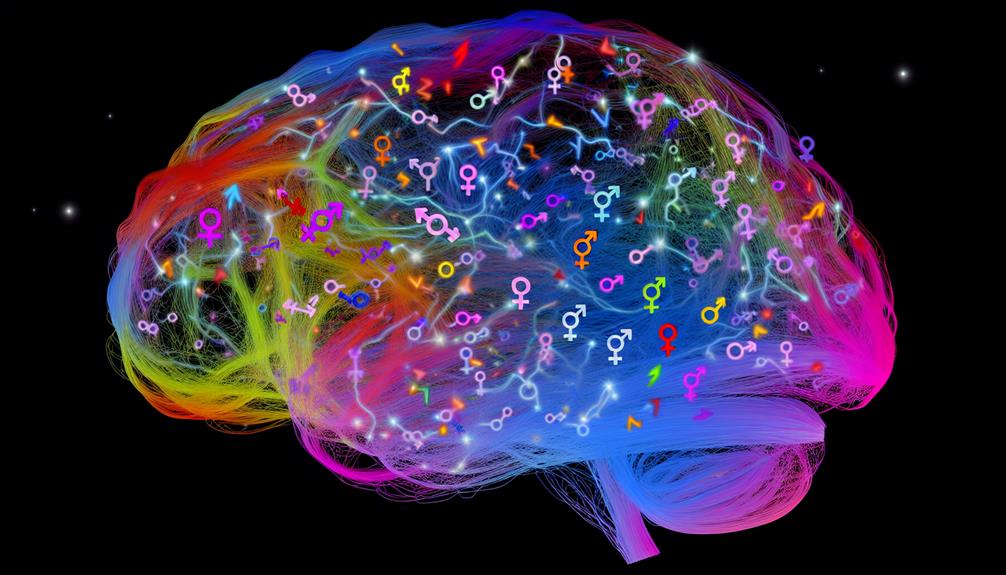
Neuroplasticity lets your brain reshape itself based on your experiences and learning throughout life. This means your brain can adapt and change, influenced by individual experiences and environmental factors. Think of it as your brain’s way of staying flexible and continuously evolving.
For example, studies have shown that London taxi drivers develop improved navigation skills, leading to noticeable changes in their brain structure. This indicates that your cognitive abilities can be shaped more by what you do and learn rather than your gender. Neuroplasticity proves that the brain isn’t fixed; it’s a dynamic organ that responds to new challenges and information.
Whether you’re acquiring a new language, learning to play an instrument, or honing a specific skill, neuroplasticity guarantees that your brain can adapt and grow. This adaptability breaks down the idea that certain cognitive abilities are inherently tied to gender. Instead, your unique experiences and the environment you’re in play a significant role in shaping your brain.
Understanding neuroplasticity helps us appreciate that everyone’s brain has the potential to change and improve. It encourages a more inclusive view, focusing on individual potential rather than generalized assumptions based on gender.
Your brain’s ability to adapt isn’t just about what you learn but also how society shapes your experiences from a young period of life. Societal norms play a big role in brain development by influencing the types of toys you play with, which can reinforce traditional gender roles. For example, girls might be encouraged to play with dolls, fostering nurturing behaviors, while boys are often given building blocks, which can enhance spatial skills.
As you grow, societal expectations continue to shape your social behavior and career choices. Gender roles can lead to self-fulfilling prophecies, where you might believe you’re better suited for certain tasks simply because they align with societal norms. This can be particularly evident in areas like math, where stereotype threat can negatively impact performance. If you’re aware of a stereotype suggesting that your gender isn’t good at math, you might underperform due to diminished confidence.
Ultimately, the environment plays a significant role in brain development. The experiences, education, and socialization practices you encounter shape your cognitive abilities and gender identity. Understanding these influences helps us see that brain differences are driven more by societal conditioning than by inherent biological factors.

Did you know that many beliefs about ‘male’ and ‘female’ brains are actually myths? The idea that there are significant, hardwired differences in brains between sexes is often exaggerated. Many of these beliefs stem from sexist stereotypes rather than scientific facts.
For example, differences in brain structure often disappear when you account for total brain size. Most variations are found within genders, not between them. Neuroplasticity also shows that your brain can change and adapt based on your experiences, education, and activities. This means that society encourages certain behaviors and skills, shaping your brain in specific ways.
Here’s a quick comparison to debunk some common myths:
| Myth | Reality |
|---|---|
| Men’s brains are better at math. | Both sexes have similar potential; social factors matter. |
| Women’s brains are wired for empathy. | Empathy is developed through experience and environment. |
| Boys prefer mechanical toys naturally. | Preferences are shaped by societal influences. |
| Girls are naturally better at language. | Both genders can excel; differences are minimal. |
| Brain imaging shows clear sex-based differences. | Often misinterpretations and overhyped findings. |
Don’t let misinterpretations fool you. Understanding that brain development is influenced by many factors helps break down these outdated stereotypes.
You might wonder how female brains differ from male brains.
Women’s brains usually have a larger hippocampus, aiding memory and learning, while men’s brains often feature a bigger amygdala, handling emotions.
Women tend to excel in verbal skills and fine-motor tasks, whereas men often do better in visuospatial tasks.
You’re probably wondering if you’ve got a female brain or a male brain. Honestly, it’s like trying to find a needle in a haystack!
Your brain’s wiring isn’t just about gender. It’s shaped by your unique experiences, learning, and environment.
Sure, there might be some differences, but they’re overshadowed by how you’ve lived and what you’ve done.
Accept your brain’s uniqueness; it’s what makes you, you!
In relationships, your female brain often excels at empathy and emotional connection. You might find that you remember emotional moments vividly, which helps you understand and support your partner.
Your ability to pick up on verbal and nonverbal cues can improve communication. Hormonal cycles, like those involving estrogen, can influence your mood and emotions, making you more attuned to nurturing and building intimacy.
Did you know boys are diagnosed with autism four times more often than girls?
Boys and girls do exhibit some brain differences. For instance, boys generally have larger amygdalae, which are linked to emotion regulation, while girls often have larger hippocampi, essential for learning and memory.
These differences suggest unique strengths and tendencies, but remember, individual experiences and societal influences play a huge role in shaping behavior.
By looking beyond the surface, we see that our brains are like clay, shaped by life’s experiences rather than strict blueprints.
Don’t let the myth of a ‘girl brain‘ or ‘boy brain‘ box you in. Welcome your unique expedition, where each twist and turn molds your mind.
Remember, it’s your story that crafts who you are, not outdated stereotypes.
Break free and celebrate the limitless potential within your own beautifully sculpted brain.
Originally posted 2024-10-07 17:03:47.

 Featured PostsOctober 8, 2026Say NO to Props 134 & 135 in Colorado
 Featured PostsSeptember 29, 2026A Kansas Law Voided 1,700 Licenses. Now Judges Must Decide Whether It Stands
 Featured PostsSeptember 29, 2026Election Season & Transgender Rights: Reporting Responsibly in a Divided America
 Featured PostsSeptember 29, 2026Privacy, Dignity, and Rights: The Transgender Bathroom Controversy